
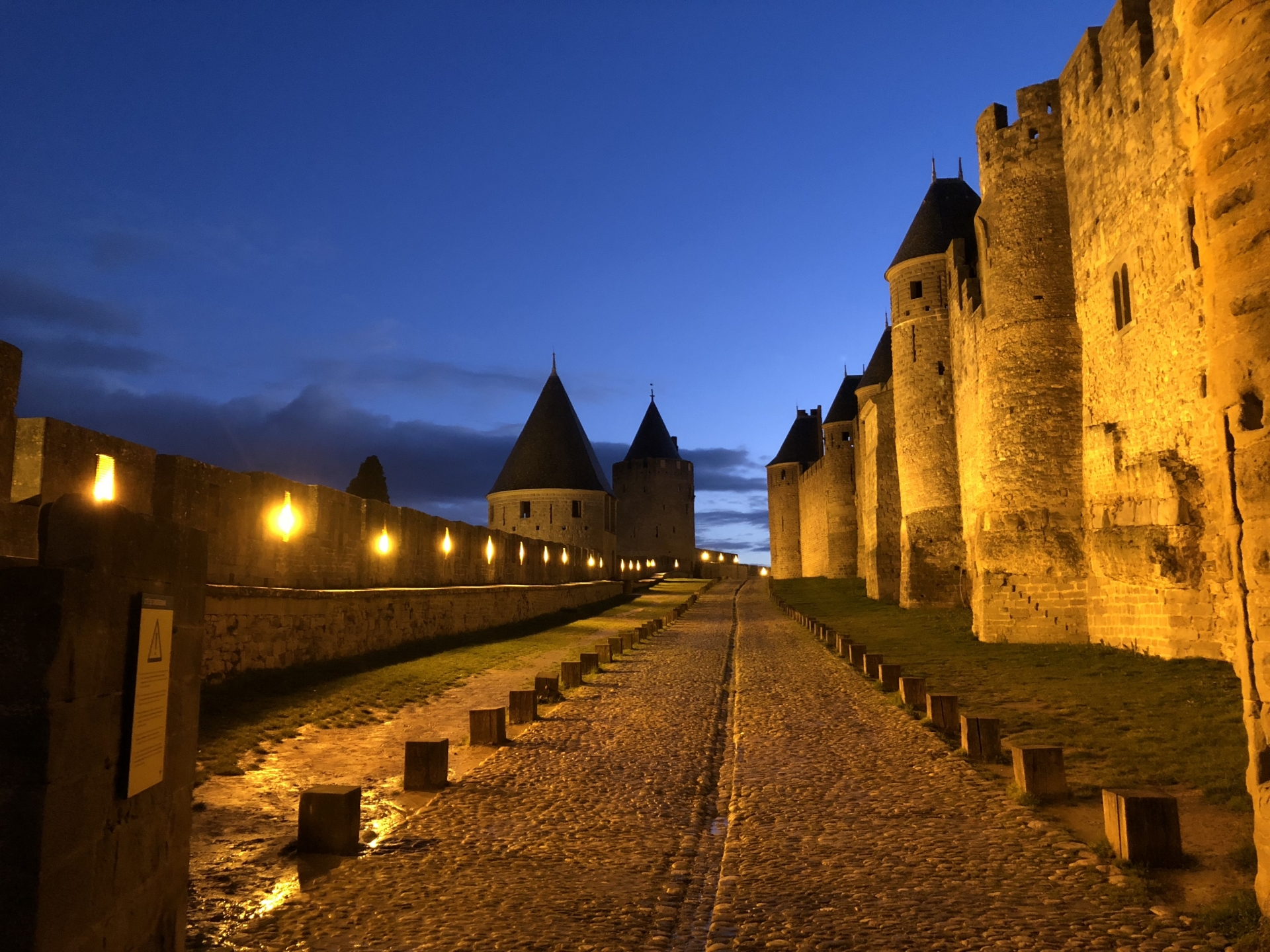
Stone vs. Shakes: The fundamental difference in castle DNA
I imagine many of you have seen the above image. It’s the formidable medieval fortress of Carcassonne in France, now a UNESCO World Heritage site and a hugely popular tourist destination. This site, which I had shamefully never seen before this research, sparked my interest in finding the fundamental differences between European and Japanese castles.
In Japan, we have a curious linguistic habit. While “Castle” and “Shiro” (城) mean the exact same thing, the loanword “Castle” almost always conjures images of European stone spires in our minds, while “Shiro” is reserved strictly for the wooden bastions of our ancestors. It is as if our brains have categorized them into two entirely different species of power.
Anyone would immediately notice the basic building material difference: stone in European castles versus wood in Japanese ones. But the real difference lies in the DNA of the architecture. European castles were designed for impenetrable, static defense against siege weapons and mass armies. They incorporated large residential areas inside, surrounded by high, thick stone walls.
Japanese castles, conversely, were designed with a necessary weakness: they had to survive earthquakes. Their tall structures, built mostly of layered wood, employed flexible, non-load-bearing stone bases, allowing them to sway and absorb seismic shock. This geographical condition—the incessant threat of the earth shaking—forced a less visually dominating, yet structurally more resilient design.
You might wonder: Is wood really appropriate for a fortress prone to fire attacks? Paradoxically, yes. While fire arrows were a threat, thick timber has a secret defense: when exposed to flame, the surface chars into a carbonized layer that acts as thermal insulation, cutting off oxygen and preserving the core’s structural integrity. Combined with thick, fire-resistant plaster, these wooden giants were far more resilient to fire than their fragile appearance suggests.
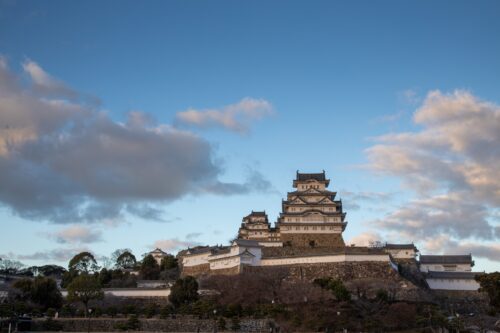
The civil war divide: Why Japanese samurai abandoned their people
Now, let’s address a striking political difference: Why didn’t Japanese castles usually include a large residential area inside the inner walls? I looked it up, and the reason appears to lie in the fundamental difference in the character of warfare. In medieval Europe, conflicts often escalated into total war where the general populace was the target of attack, hence the need for a castle to serve as a comprehensive refuge for the entire community.
During the Samurai age in Japan, however, conflicts were typically a form of civil war—localized fights between rival samurai clans. The general populace was, surprisingly, not the primary target of attack. While the samurai killed each other on the battlefield, the common people simply went about their daily lives outside the castle walls or battle areas. Therefore, the Japanese castle’s main purpose was strictly the defense of the ruling lord and his military, not the protection of the townspeople. It was a fortress of political power, not communal defense.
But there is a darker truth behind this social contract. Because the townspeople were not protected, they often viewed all soldiers—friend or foe—with deep-seated resentment. It is a grim historical fact that defeated samurai fleeing a battlefield were frequently hunted down and killed by the local peasants they had neglected. The castle walls didn’t just keep enemies out; they kept a hostile, vengeful populace at arm’s length. It was a fortress of political power, not communal defense.
The cross-cultural mirror: Why I needed France to see Japan
What I found most interesting through this quick research is the profound impact of cultural components—such as political situations, climate, and geography—on something as concrete as castle architecture. Despite having the same basic purpose (defense against enemies), the shape of castles in Europe and Japan are totally distinct.
In that sense, our furniture will inevitably become unique and distinctly Japanese because it is made by Japanese craftspeople here in Japan using Japanese wood. The problem is that sometimes we, as humans, cannot recognize our own uniqueness. As the Japanese saying goes, we “can’t see the forest for the trees.”
This is why cross-cultural understanding is so vital. I, a resident of Hokkaido—a place with no ancient castles, only modern self-reliance—am amused to admit I needed the image of a formidable stone fortress in France to truly understand the subtle resilience and political history embedded in the wooden structures of Japan. It is a wonderfully human paradox that understanding the “other” is the only way to genuinely see the unique value of the “self.”
It is a humbling truth that I, a man who makes his living from wood, had to look at a French stone fortress to finally understand the genius of Japanese timber. Apparently, my own “cultural eye” is as reliable as a compass in a magnet factory. But this moment of self-discovery led me to a radical conclusion: if we are too blind to see our own uniqueness, why not collaborate with someone who is impossible to ignore?
Enter the Hatsune Miku Art Chair—a fusion of the resilient wood I almost overlooked and a virtual icon the world can’t stop watching. It is a piece designed for those who, like me, occasionally need a vibrant, teal-haired wake-up call to realize that the heritage right under our noses is extraordinary. The image below is more than just a visual; it is your portal to this cross-cultural masterpiece. Click the banner to explore the Hatsune Miku Art Chair special website and see how tradition finds its future.


Shungo Ijima
Global Connector | Reformed Bureaucrat | Professional Over-Thinker
After years of navigating the rigid hallways of Japan’s Ministry of Finance and surviving an MBA, he made a life-changing realization: spreadsheets are soulless, and wood has much better stories to tell.
Currently an Executive at CondeHouse, he travels the world decoding the “hidden DNA” of Japanese culture—though, in his travels, he’s becoming increasingly more skilled at decoding how to find the cheapest hotels than actual cultural mysteries.
He has a peculiar talent for finding deep philosophical meaning in things most people ignore as meaningless (and to be fair, they are often actually meaningless). He doesn’t just sell furniture; he’s on a mission to explain Japan to the world, one intellectually over-analyzed observation at a time. He writes for the curious, the skeptical, and anyone who suspects that a chair might actually be a manifesto in disguise.
Follow his journey as he bridges the gap between high-finance logic and the chaotic art of living!