

The hubris of the zebra
Today, our high-quality furniture is made possible through a fusion of cutting-edge CNC machines and traditional craftsmanship. In our factory, you’ll find artisans carving wood with the intuition of a lifetime alongside experts who operate multiple CNC machines with the latest technical knowledge. It was in this setting, while watching a machine navigate the complex curves of a chair, that I found myself thinking—strangely enough—of a zebra.
To be precise, I was remembering a time when I felt a desperate sense of relief and joy upon learning that AI couldn’t recognize a zebra. It was a fragile straw I clung to, a way of telling myself, “See? There are still things where humans are superior.” This is known as the “Symbol Grounding Problem.” You can tell an AI that a zebra is “a horse with stripes,” and it will store those 17 characters perfectly. But because the AI has no “grounding”—no physical experience of what a horse or a stripe actually is—it could look right at a zebra and see nothing but noise. I laughed to mask my anxiety, thinking, “At least I know what a zebra is.”
The 3D revolution: AI gets a body (sort of)
That desperate sense of relief didn’t last long. With the advent of 3D CG data and advanced image recognition, AI learned to verify visual information against 3D shapes. It stopped looking at “strings of text” and started looking at “geometry.” Suddenly, the AI could “see” the zebra. My smug superiority quickly turned into a profound awe of technology.
This same innovation transformed our factory. In the old days, operating a CNC machine required us to manually input endless strings of numerical coordinates. Today, we scan a hand-carved prototype (like the one in the photo) into 3D data, and the computer calculates the complex paths for the drill bits automatically. The “symbols” are now grounded in “shape.”
The 0.1mm wall: Where AI hits a dead end
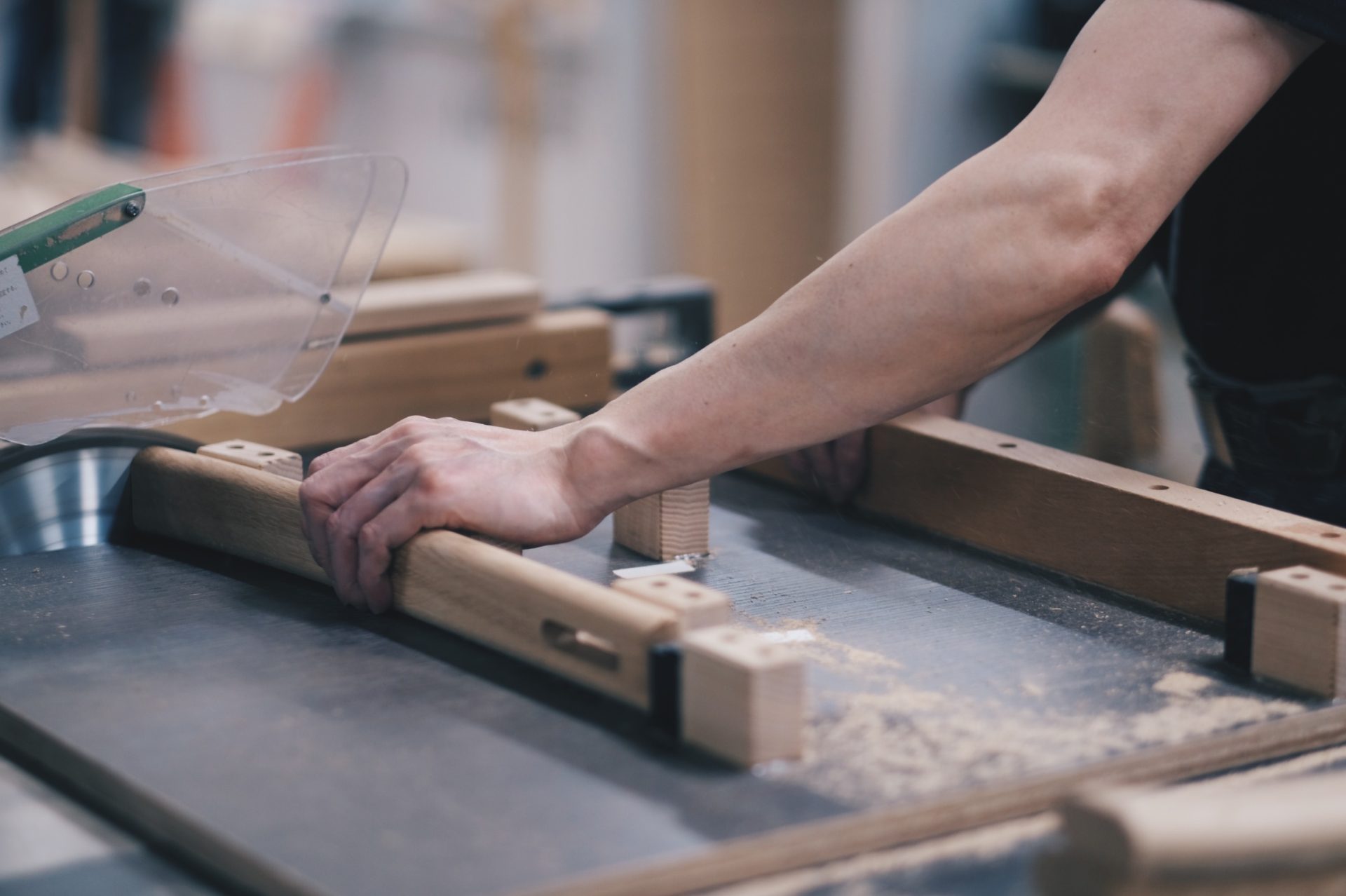
Looking at our high-tech factory, you might think furniture production has become as easy as pressing “Print.” But here is the catch: AI still doesn’t have hands. Even with perfect 3D data, the CNC machine is only as good as the person who “sets” the wood. Wood is a living, breathing material. It expands with humidity and shrinks with heat. If a craftsman places a raw wooden block into the CNC machine even 0.5mm off-center, the entire piece is ruined. The AI can calculate the path, but it cannot “feel” the tension in the wood or the slight vibration of a dull blade.
This is the new Symbol Grounding Problem. AI understands the geometry, but it doesn’t understand the gravity or the friction. It takes a human expert to bridge the gap between the digital dream and the physical reality. At CondeHouse, our CNC machines do the heavy lifting, but our craftsmen provide the “grounding.”
Hatsune Miku is the ultimate “ungrounded” symbol—a star born from digital code. But the Hatsune Miku Art Chair is where that symbol finally meets the earth. We took the flawless 3D geometry of a virtual icon and handed it over to our craftsmen, who had to navigate the unpredictable “friction” of real Hokkaido timber. It is a piece that solves the Symbol Grounding Problem by turning pixels into something you can actually touch and sit on. Why settle for a digital image when you can own the physical manifestation of a dream, grounded by human hands?
Ready to feel the “grounded” reality of digital art? Click the banner below to see the Art Chair collection up close.


Shungo Ijima
Global Connector | Reformed Bureaucrat | Professional Over-Thinker
After years of navigating the rigid hallways of Japan’s Ministry of Finance and surviving an MBA, he made a life-changing realization: spreadsheets are soulless, and wood has much better stories to tell.
Currently an Executive at CondeHouse, he travels the world decoding the “hidden DNA” of Japanese culture—though, in his travels, he’s becoming increasingly more skilled at decoding how to find the cheapest hotels than actual cultural mysteries.
He has a peculiar talent for finding deep philosophical meaning in things most people ignore as meaningless (and to be fair, they are often actually meaningless). He doesn’t just sell furniture; he’s on a mission to explain Japan to the world, one intellectually over-analyzed observation at a time. He writes for the curious, the skeptical, and anyone who suspects that a chair might actually be a manifesto in disguise.
Follow his journey as he bridges the gap between high-finance logic and the chaotic art of living!