
The curse of the second installment
The Matrix Reloaded, Blues Brothers 2000, Speed 2. Cinema history is littered with the wreckage of sequels that failed to live up to the original. In the business world, the pressure on a successor is even more intense. How do you follow a “legendary” founder without crashing the ship?
Typically, if a company survives long enough to pass the torch, the founder is almost certainly a person of legendary talent. However, to adapt to a changing world, the successor is often required to reject the very methods that made the founder successful. This pressure is unimaginable—especially since founders are rarely the type to sit quietly in the background. The same “strong ego” that made them successful usually prevents them from letting go. Our founder at CondeHouse was no exception; his will was a force of nature, and I bow in respect to the hardships our second president must have endured.
That said, now that our second president has become the Chairman, I often see him doing the exact same thing to our third and current president. It seems the cycle of “the strong-willed predecessor” is a hard one to break, so perhaps I shouldn’t praise him too much!
The audacious logic of the U.S. launch
Despite the internal pressures, the second president proved his mettle early on. In 1984, while still in his 30s, he was sent to the U.S. to establish our branch office. His first move was a calculated gamble: he overhauled the entire Corporate Identity (CI). He gathered a team of experts and rebuilt the brand name, logo, and store interiors—all without the approval of our “hot-blooded” founder back in Japan.
In the mid-80s, when “Systematic Branding” was a foreign concept in Japan, this move was a masterclass in cold, hard logic. He knew that to win in the American market, we needed to speak their visual language. He showed the nerves of a high-stakes gambler backed by the brain of an architect.
The art of the defensive pivot
As Sun Tzu suggested in The Art of War, defense is much harder than offense. While the second president was brilliant at expansion, his true value emerged during the 2008 Financial Crisis.
When the Japanese economy spiraled, he didn’t panic; he calculated. Everything was judged through the lens of logic. He made the surgical decision to drastically cut labor costs, beginning with his own salary. While 16,000 Japanese companies collapsed that year, CondeHouse remained standing. He proved that sometimes, the most emotional thing you can do for your employees is to remain perfectly unemotional in your judgment.
The logic of embracing the irrational
Once, I asked him, “Even logic can’t predict the future perfectly. How do you decide when the data is unclear?”
He grinned and gave me a surprisingly “illogical” answer: “If someone comes back for approval after being rejected three times, I give them the green light—even if my logical brain says ‘No’.”
In his world, even human passion and “irrational persistence” are factored into the equation. He understands that a company cannot grow on logic alone, but it cannot survive on passion alone either. After the feverish, chaotic early years under our founder, it was the second president’s unwavering logic that finally laid the tracks for our long-term growth.
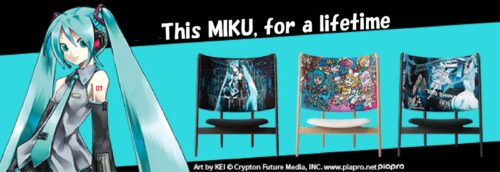
I confess that I’m inspired by the ‘defensive pivot’—because surviving a global crisis requires a logic so cold it borders on the heroic. At CondeHouse, we’ve learned that a brand needs the feverish passion of a founder to start, but the unwavering logic of a successor to endure. Our Hatsune Miku Art Chair is the perfect ‘sequel’ to our legacy. It isn’t just an emotional collaboration; it is a masterclass in strategic logic. We took a global phenomenon and applied the rigorous, architectural standards that have kept us standing for decades. It is a masterpiece where human persistence meets surgical precision. Now, here is a portal to a brand that survived the storm: the image below is your link to the special site. If you prefer the fleeting, illogical trends of the moment, do NOT click it. But if you’re ready to invest in a legacy built on hard-earned logic, go ahead. Join the survival. —— The Hatsune Miku Art Chair.

Shungo Ijima
Global Connector | Reformed Bureaucrat | Professional Over-Thinker
After years of navigating the rigid hallways of Japan’s Ministry of Finance and surviving an MBA, he made a life-changing realization: spreadsheets are soulless, and wood has much better stories to tell.
Currently an Executive at CondeHouse, he travels the world decoding the “hidden DNA” of Japanese culture—though, in his travels, he’s becoming increasingly more skilled at decoding how to find the cheapest hotels than actual cultural mysteries.
He has a peculiar talent for finding deep philosophical meaning in things most people ignore as meaningless (and to be fair, they are often actually meaningless). He doesn’t just sell furniture; he’s on a mission to explain Japan to the world, one intellectually over-analyzed observation at a time. He writes for the curious, the skeptical, and anyone who suspects that a chair might actually be a manifesto in disguise.
Follow his journey as he bridges the gap between high-finance logic and the chaotic art of living!
Comments
List of comments (2)
[…] was more room for pathos or passion in product development. Once, I bothered the immediate past chairman with a large number of questions about the marketing strategy of a new product. He answered […]
[…] more on psychological factors for problem solving. As writing above, I’m a kind of believer of logical thinking, but I like his idea, because I know we very often behave irrationally and illogically, which, I […]