
Zombies vs. Aliens: The fear of the familiar
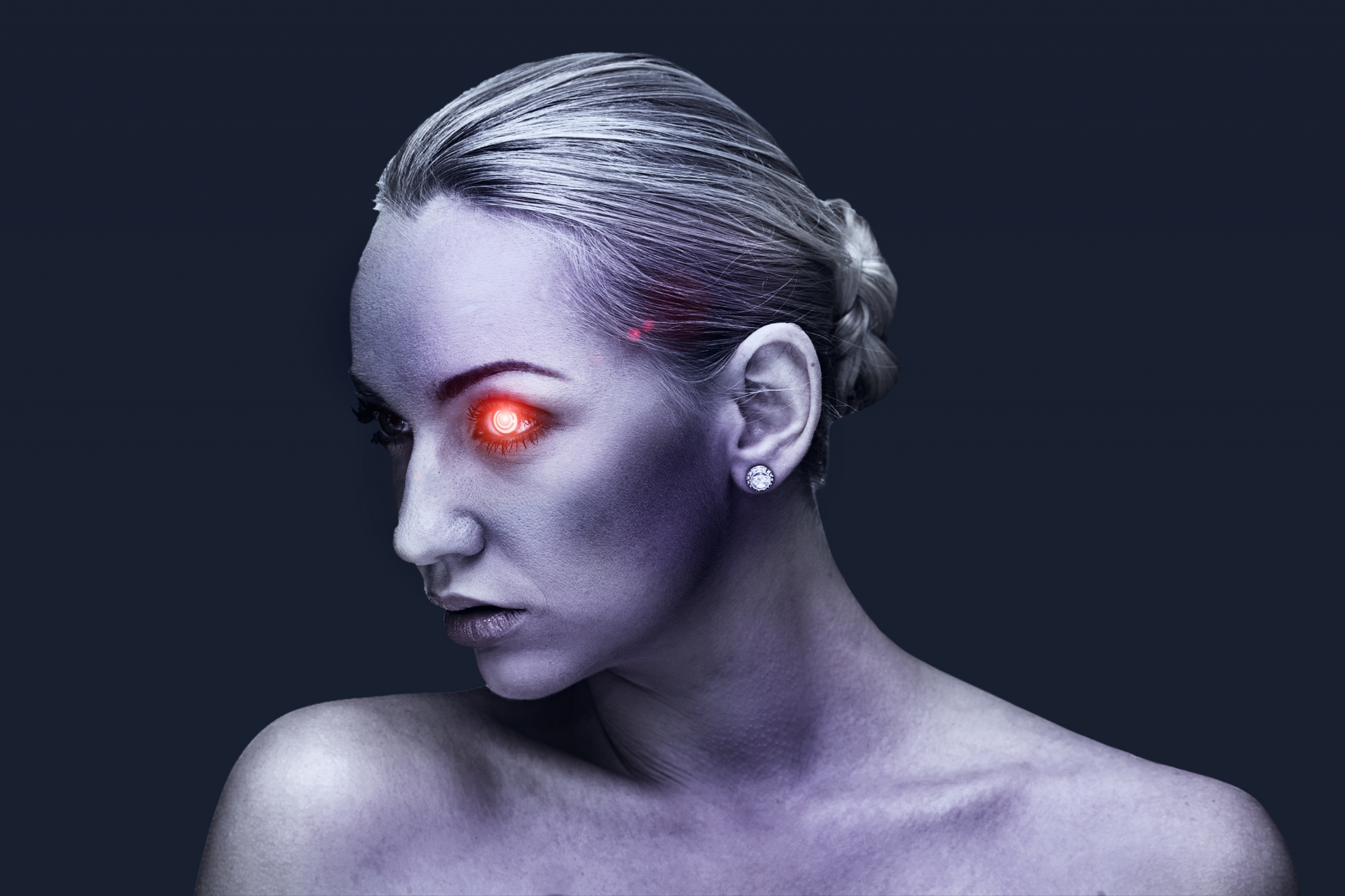
I’ve always wondered why I find zombie movies terrifying, yet feel almost nothing watching Alien, Predator, or even the raptors in Jurassic Park. Strictly speaking, those cinematic monsters are far more efficient killers—their “lethality” is off the charts. Yet, the visceral, disgust-fueled fear I feel toward zombies is much stronger.
I used to think it was the hygiene factor—the tattered, filthy clothes—but then I realized: if a zombie were completely naked, it would be infinitely more terrifying. So, why the difference? One day, while reading an article about humanoid robots developed at Osaka University, I found the answer.
The researchers had created robots that looked incredibly lifelike. At a standstill, they were indistinguishable from humans. But the moment they moved—a slight stutter in the eyelids or a mechanical stiffness in the neck—a wave of revulsion hit me. It was the exact same dread I felt watching a zombie. I realized then: we aren’t afraid of what is “different”; we are afraid of what is “almost right, but slightly wrong.”
Into the Uncanny Valley
This psychological phenomenon is known as the “Uncanny Valley.” The theory suggests that as an object’s appearance becomes more human, our sense of affinity increases—until it reaches a point of near-perfection. Just before it becomes indistinguishable from a real human, there is a sharp dip into a “valley” of eeriness.
This reaction is deeply rooted in our biology. Neuroscience points to a mechanism called “lateral inhibition.” Our brains are evolved to be hyper-sensitive to boundaries. Imagine lining up several grey plates, each a slightly different shade. At the boundary where a light plate meets a dark one, the edge of the light plate looks even lighter, and the dark one darker. Our brains naturally exaggerate differences at the border. When a robot (or a zombie) sits right on the border between “object” and “human,” our brains go into overdrive, triggering a primal “danger” signal.
This is why character designers in animation and film carefully avoid this valley by making sure their characters are clearly not human. Think about Studio Ghibli’s masterpiece, My Neighbor Totoro. We love Totoro because he is a fuzzy, supernatural spirit. But imagine for a second if Totoro looked like a human—that massive frame, that deafening roar, and that inscrutable, blank expression. If he were human-shaped, it wouldn’t be a heartwarming tale; it would be the most terrifying horror movie ever made.

The comfort of organic shapes
This leads me to a fascinating realization about design. If we are so sensitive to human-like traits, why are we drawn to “organic” shapes in furniture?
Making curved, organic furniture requires advanced techniques and higher costs compared to simple, straight lines. Yet, we continue to pursue these shapes because they evoke a sense of life and affinity. The key, however, is staying safely on the “friendly” side of the Uncanny Valley.
Take our CRUST Collection by Raw-Edges, for example. The arms of these chairs are organic and flowing, echoing the soft curves of a living being, but they never attempt to mimic human skin or anatomy. They provide the warmth of “life” without the mechanical deception. By embracing organic forms while maintaining their identity as handcrafted objects, we create furniture that feels like a companion—never a stranger.
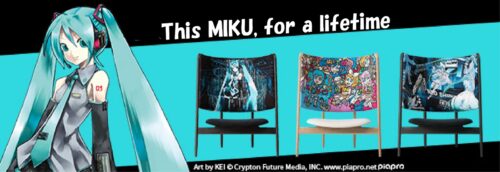
I confess that I’m terrified of the ‘almost human’—the mechanical stutter of a robot or the hollow gaze of a zombie. At CondeHouse, we know that true comfort isn’t found in a perfect mimicry of life, but in capturing its organic warmth while remaining honestly, beautifully wood. Our Hatsune Miku Art Chair is our triumph over the ‘Uncanny Valley.’ We didn’t try to make a doll or a machine; we used the flowing, artisan curves of our finest Hokkaido timber to create a companion that feels alive, yet stays true to its identity as a masterpiece of craft. It is the turquoise-green spirit of Miku, given a physical form that provides comfort, not dread. Now, here is a portal to a design you can trust: the image below is your link to the special site. If you prefer the cold, mechanical deception of the synthetic, do NOT click it. But if you’re ready to welcome a ‘living’ masterpiece into your home, go ahead. Embrace the warmth. —— The Hatsune Miku Art Chair.
Shungo Ijima
Global Connector | Reformed Bureaucrat | Professional Over-Thinker
After years of navigating the rigid hallways of Japan’s Ministry of Finance and surviving an MBA, he made a life-changing realization: spreadsheets are soulless, and wood has much better stories to tell.
Currently an Executive at CondeHouse, he travels the world decoding the “hidden DNA” of Japanese culture—though, in his travels, he’s becoming increasingly more skilled at decoding how to find the cheapest hotels than actual cultural mysteries.
He has a peculiar talent for finding deep philosophical meaning in things most people ignore as meaningless (and to be fair, they are often actually meaningless). He doesn’t just sell furniture; he’s on a mission to explain Japan to the world, one intellectually over-analyzed observation at a time. He writes for the curious, the skeptical, and anyone who suspects that a chair might actually be a manifesto in disguise.
Follow his journey as he bridges the gap between high-finance logic and the chaotic art of living!