
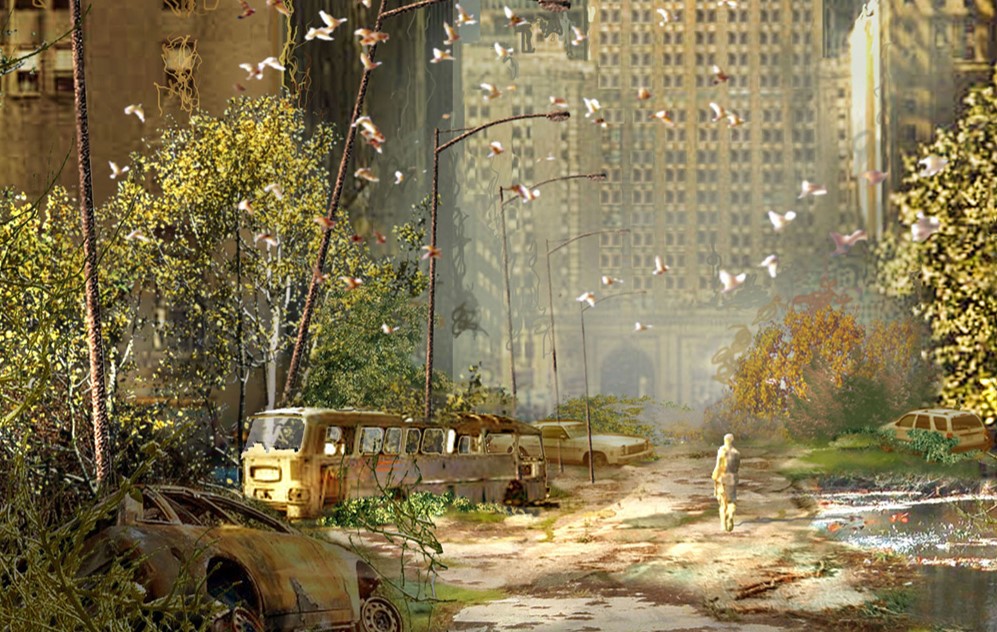
The sci-fi thought experiment
I am a huge fan of sci-fi. To me, they aren’t just movies; they are the ultimate thought experiments. George Orwell’s 1984 asks, “What if totalitarianism won?” Blade Runner asks, “What if androids were more human than us?”
But the movie that haunts me most is I Am Legend starring Will Smith. It’s the story of the last man on Earth. Every time I watch it, I ask myself the same question: “What would I do if I were Will Smith?”
The answer is always the same, and it’s deeply depressing: I would die. Almost immediately.
The fatal rule of three
In the movie, Will Smith scavenges for canned food. I’d do the same, but I’d be paralyzed by a single thought: “What happens when I finish the last can of tuna?” I don’t know how to preserve meat. I don’t know how to make a can. Hell, I don’t even know how to forge the metal for a can opener.
Then there’s the “Rule of Three.” You can survive three minutes without air, three weeks without food, but only three days without water. In a world where the taps have stopped running, I would be wandering the streets of Asahikawa like a lost puppy. Once the last bottle of mineral water is gone, so am I. I am not a “Legend.” I am a casualty.
The illusion of independence
This realization was a shock to my ego. I realized that my survival—and yours—is entirely dependent on a massive, invisible web of collective knowledge.
We live in a world filled with things we use every day but don’t actually understand. Do you know how your smartphone works? Could you build a chair from scratch if your life depended on it? We enjoy the fruits of science and technology, but we have lost the “how.” Our modern world is a masterpiece of interdependence. This hidden anxiety—the fear that we are surrounded by magic we can’t control—is, I believe, what secretly drives people to visit our factory.

Solving the mystery of the “organic” chair
Take our furniture, for example. When you look at a finished CondeHouse chair, it looks seamless, organic, and almost as if it grew out of the ground that way. The joints are hidden; the structure is a mystery.
To be honest, even for those of us who work here (the ones not in production), looking at a finished chair is like looking at a UFO. How did they join those parts? How did they get that curve?
If the world ended tomorrow, I wouldn’t know how to fix my own chair. And that’s why I invite you to our factory tour. It’s not just a “business visit.” It’s an antidote to the anxiety of the modern world. Come and see how things are actually made. Learn how a piece of wood becomes a structure. In a world that feels increasingly like a “black box,” our factory tour is a rare chance to see the light inside.
Come join us. Because if a zombie apocalypse ever actually happens, you’ll at least want to know how to build a sturdy chair to sit on while you wait for the end!
The modern world is built on connections we often take for granted. Why not own a piece of furniture that celebrates the transparent honesty of craftsmanship? Visit our factory, see the “how,” and bring home a chair that isn’t a mystery—it’s a masterpiece.


Shungo Ijima
Global Connector | Reformed Bureaucrat | Professional Over-Thinker
After years of navigating the rigid hallways of Japan’s Ministry of Finance and surviving an MBA, he made a life-changing realization: spreadsheets are soulless, and wood has much better stories to tell.
Currently an Executive at CondeHouse, he travels the world decoding the “hidden DNA” of Japanese culture—though, in his travels, he’s becoming increasingly more skilled at decoding how to find the cheapest hotels than actual cultural mysteries.
He has a peculiar talent for finding deep philosophical meaning in things most people ignore as meaningless (and to be fair, they are often actually meaningless). He doesn’t just sell furniture; he’s on a mission to explain Japan to the world, one intellectually over-analyzed observation at a time. He writes for the curious, the skeptical, and anyone who suspects that a chair might actually be a manifesto in disguise.
Follow his journey as he bridges the gap between high-finance logic and the chaotic art of living!