
The architecture of darkness: A sanctuary for the insomniac
When was the last time you sat in absolute pitch darkness? For most Japanese people, the planetarium is a faint, dusty memory of an elementary school field trip—an obligatory excursion spent in the company of forty restless classmates who were likely more interested in poking each other than in the Andromeda Galaxy. For the modern professional, perpetually bathed in the artificial blue light of screens, darkness has become a rare luxury.
I recently returned to the planetarium, and the experience was not what I expected. As the lights dimmed and thousands of stars rushed toward me, I felt a sensation of being “hurled” into the void—an existential vertigo that reminds you of your own magnificent insignificance.
However, my first visit resulted in a more practical discovery. I fell asleep the moment the show began. While embarrassing—and while I spent the post-show moments frantically scanning the faces of those nearby, praying my subconscious hadn’t unleashed a thunderous cacophony of snoring—I chose to view this as a “strategic success” rather than a failure of interest. I even considered a business model: using planetariums to treat the epidemic of chronic insomnia. As it turns out, Japan is already ahead of me; there are programs specifically designed to induce sleep. Ironically, during my second visit to one of these “sleep-shows” for research, I couldn’t close my eyes for a second.
Life, it seems, refuses to be optimized. It is a universal law: the day you carry an umbrella is the day it never rains, and the moment you decide to wear a pristine white shirt is precisely when you will be invited to a lunch of Curry Udon—a dish that possesses a predatory instinct for finding and ruining expensive fabrics.
The constellation cartel: A global consensus on a lie
Let’s be honest: most constellations look nothing like their names. Take Canis Minor (the Little Puppy). It is a single straight line connecting two stars. How ancient civilizations looked at a line and saw a playful puppy is a testament to either profound creative genius or a very specific type of hallucinations.
What fascinates me isn’t the “wild imagination” of our ancestors, but the cold, bureaucratic process of standardization. In 1928, the International Astronomical Union met for their third session to build a worldwide consensus on these myths. They divided the infinite chaos of the universe into exactly 88 “authorized” sectors. It was a massive diplomatic feat—the colonization of the heavens by committee.
Why bother? Because as Saint-Exupéry noted, the stars were the original GPS. These stories weren’t just folklore; they were survival data. If you didn’t remember the story of the “puppy,” you lost your way in the desert. We turned the sky into a mnemonic map to survive the earth.
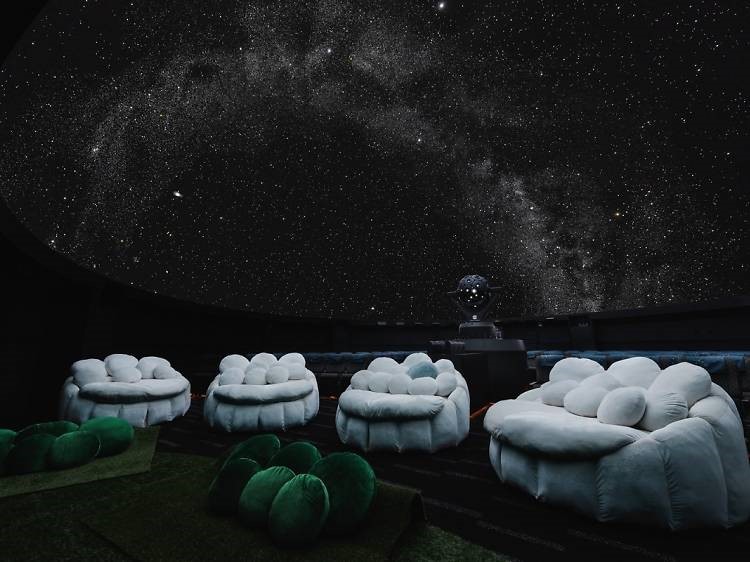
Photo credit: Best planetariums in Tokyo | Time Out Tokyo
Japan: The mecca of the high-tech void
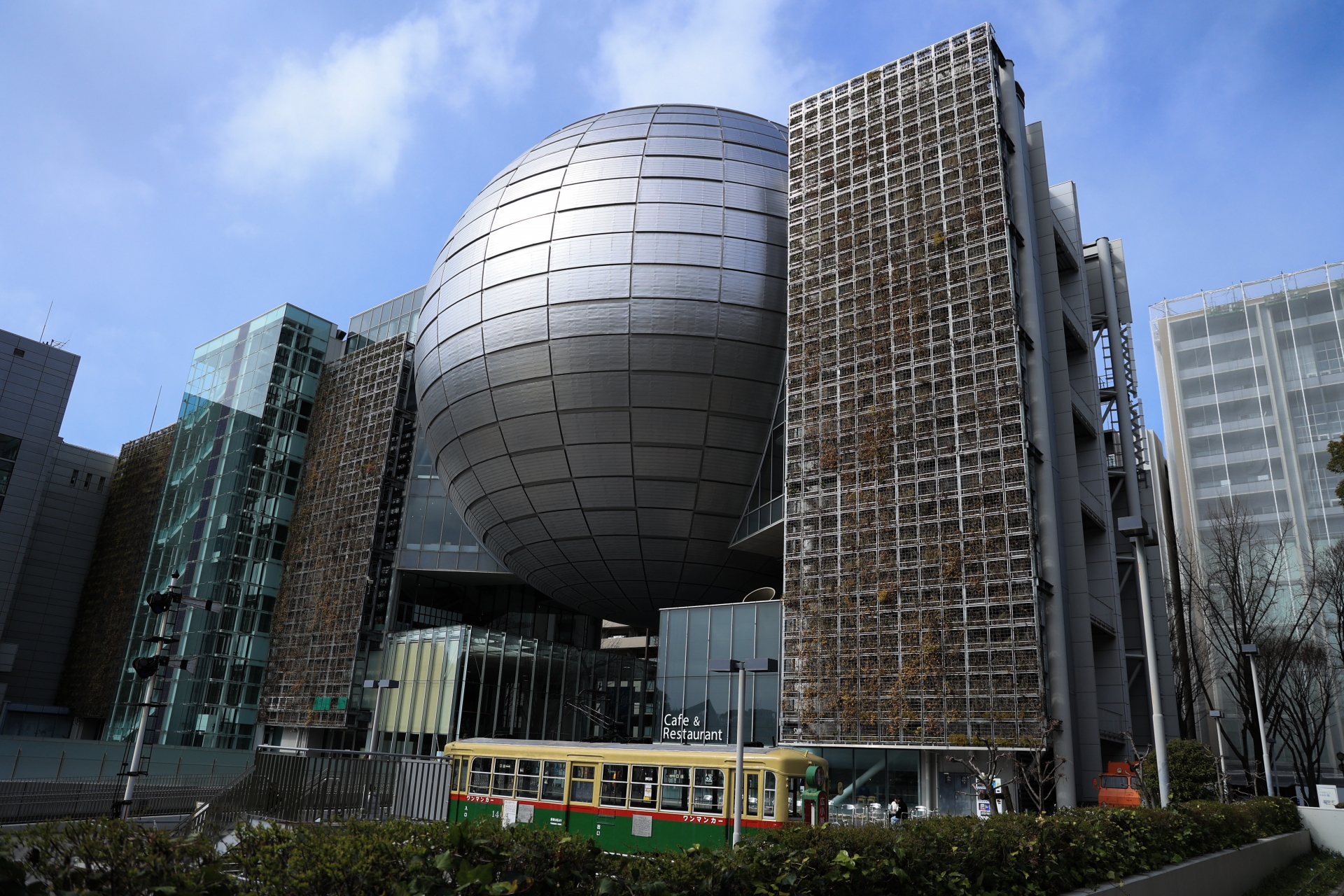
It is a little-known fact that Japan is a global superpower of the planetarium. We hold the records: Nagoya boasts the world’s largest dome (35 meters in diameter), and Japan occupies most of the top five slots globally.
Why would you visit an artificial sky when you’ve traveled all the way to Japan? Because a Japanese planetarium show is a masterclass in local perspective. The stars are calibrated to the local latitude, offering a “Hokkaido sky” or a “Tokyo sky” with obsessive precision.
In my hometown of Asahikawa, the planetarium is located within the Science Museum—a place where, interestingly, you can also experience our furniture. It is perhaps the only place on earth where you can contemplate the vastness of the cosmos while sitting on a chair crafted from the very timber that grew under those same stars.
I confess that I’m fascinated by how we turned the infinite chaos of the sky into 88 authorized sectors just so we wouldn’t lose our way. At CondeHouse, we believe that in an overwhelming world, you need a personal sanctuary—a fixed point in your own universe. Our Hatsune Miku Art Chair is that sanctuary. Crafted from the very timber that grew under the legendary Hokkaido stars and adorned with a digital icon who shines brighter than any constellation, it is a seat designed for contemplation and ‘strategic’ rest. It is a piece of the cosmos you can actually touch. Now, here is a portal to your own private planetarium: the image below is your link to the special site. If you prefer the blinding, blue-light chaos of the ordinary, do NOT click it. But if you’re ready to hurl yourself into the beautiful void of high-end design, go ahead. Find your star. —— The Hatsune Miku Art Chair.


Shungo Ijima
Global Connector | Reformed Bureaucrat | Professional Over-Thinker
After years of navigating the rigid hallways of Japan’s Ministry of Finance and surviving an MBA, he made a life-changing realization: spreadsheets are soulless, and wood has much better stories to tell.
Currently an Executive at CondeHouse, he travels the world decoding the “hidden DNA” of Japanese culture—though, in his travels, he’s becoming increasingly more skilled at decoding how to find the cheapest hotels than actual cultural mysteries.
He has a peculiar talent for finding deep philosophical meaning in things most people ignore as meaningless (and to be fair, they are often actually meaningless). He doesn’t just sell furniture; he’s on a mission to explain Japan to the world, one intellectually over-analyzed observation at a time. He writes for the curious, the skeptical, and anyone who suspects that a chair might actually be a manifesto in disguise.
Follow his journey as he bridges the gap between high-finance logic and the chaotic art of living!