

The aesthetics of decay: Ruins vs. Horror
Rusted steel frames, faded curtains fluttering out of broken windows, tableware scattered on the floor—videos showing ruined factories, hotels, and restaurants in deserted towns have become popular on platforms like YouTube recently. I must confess I often enjoy them. You might assume I’m drawn to scary things, but that is not the case.
According to Malcolm Turvey, a British professor of film studies, “Horror is a genre in which disgust is central as an emotion,” and he continues that “a lot of monsters are designed to be explicitly or implicitly disgusting.” In that sense, our interest in ruins is fundamentally different from the attraction to horror movies.
Japanese people seek and see beauty even in things decaying away. We are not fascinated by disgust, but by the visible process of time passing. I believe this deeply rooted way of thinking originates from core Japanese aesthetics.
The cult of imperfection: From full bloom to petal in a puddle
Sakura (cherry blossom) is one of Japan’s national flowers (the other is chrysanthemum, used as the crest of the Emperor). Japanese people are, without exaggeration, addicted to sakura. As most people know, cherry-blossom viewing (Hanami) is the most important seasonal tradition in spring. It is so essential that the elderly often say, “How many more times can I see cherry blossoms before I die?”
Indeed, cherry blossoms in full bloom are beautiful. But it is not only the perfect bloom that touches our heartstrings. We equally cherish the scene where the flower petals are falling (Hana-fubuki). Moreover, even a single piece of cherry blossom petal floating in a puddle often attracts us more profoundly than the thousands of flowers blooming perfectly on the trees.
The harsh logic of nature: Accepting the transient
Why are Japanese aesthetics so focused on the fleeting and the imperfect? I personally think it is inextricably linked to the natural environment of our country. As I’ve mentioned in previous articles, Japan is an island nation prone to numerous natural disasters such as tsunamis and earthquakes.
In such a harsh environment, constantly faced with a feeling of powerlessness before nature’s fury, we have no choice but to accept a fundamental reality: we are an ephemeral part of nature, and death is an inseparable part of life.
This philosophy is the foundation of Wabi-Sabi—finding beauty in transient and imperfect things. This is precisely why we Japanese love sakura so much: The flowers disperse quickly, serving as a perfect annual reminder of life’s beautiful, yet swift, impermanence.
The Wabi-Sabi of wood: Honoring the uneven character
This ancient aesthetic is not confined to gardens and ruins; it applies directly to our craft.
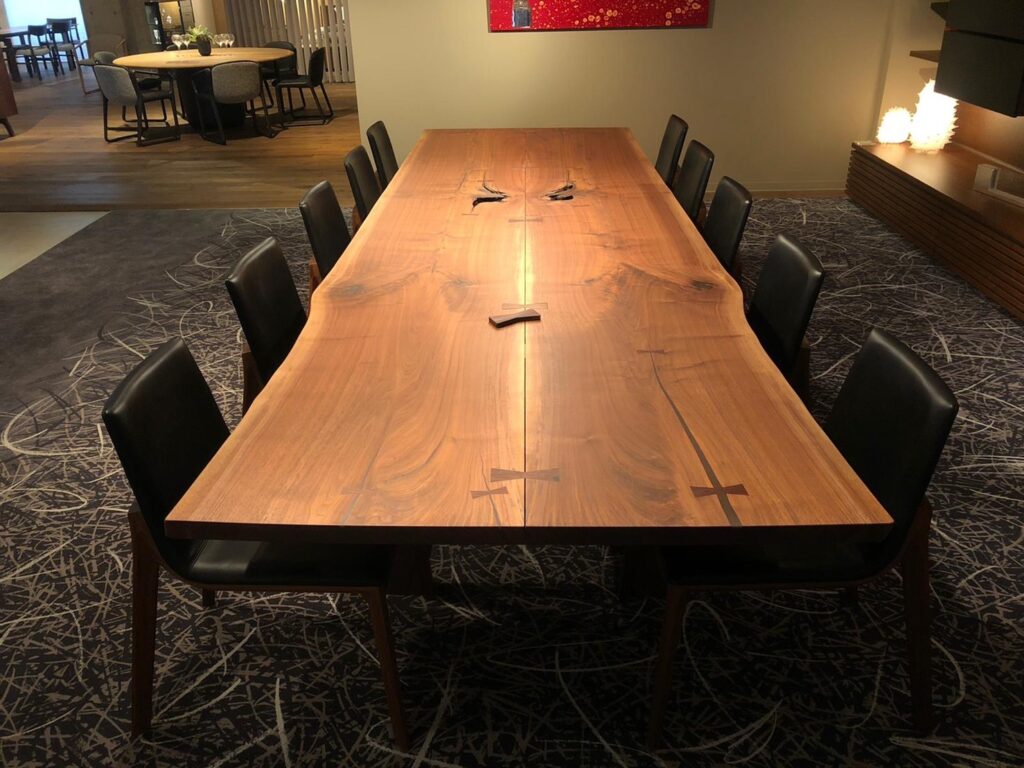
Our furniture is made of natural wood. Each piece of wood has its own unique characteristics (grain, color, texture) and is liable to change and age over time. In the sense of Japanese aesthetics—the Wabi-Sabi born from accepting impermanence—wooden furniture with uneven characters and signs of aging is regarded as inherently more beautiful than something that is sterile and flawless.
When you choose our wooden furniture, you are not just buying an object; you are acquiring a piece of nature that will beautifully decay and evolve alongside you. The decay is the design.
I confess that while I’ve learned to appreciate the ‘wabi-sabi’ of a rusting factory or a falling petal, I find it much harder to admire the increasing ‘imperfections’ in my own bathroom mirror. It seems nature is far more generous to wood and steel than to humble furniture makers. Our Hatsune Miku Art Chair, however, is designed to be the perfect companion for this transient journey. We’ve paired the eternal, flawless digital glow of a legend with Hokkaido timber that is ready to age, darken, and evolve beautifully alongside you. It is a piece where ‘the decay is the design’—a seat that grows more soulful with every passing year, even as we mortals do the same. Come and embrace the beauty of the fleeting with a chair built to last a lifetime. —— The Hatsune Miku Art Chair.


Shungo Ijima
Global Connector | Reformed Bureaucrat | Professional Over-Thinker
After years of navigating the rigid hallways of Japan’s Ministry of Finance and surviving an MBA, he made a life-changing realization: spreadsheets are soulless, and wood has much better stories to tell.
Currently an Executive at CondeHouse, he travels the world decoding the “hidden DNA” of Japanese culture—though, in his travels, he’s becoming increasingly more skilled at decoding how to find the cheapest hotels than actual cultural mysteries.
He has a peculiar talent for finding deep philosophical meaning in things most people ignore as meaningless (and to be fair, they are often actually meaningless). He doesn’t just sell furniture; he’s on a mission to explain Japan to the world, one intellectually over-analyzed observation at a time. He writes for the curious, the skeptical, and anyone who suspects that a chair might actually be a manifesto in disguise.
Follow his journey as he bridges the gap between high-finance logic and the chaotic art of living!
Comments
List of comments (1)
[…] example. These days, many rail enthusiasts are coming to Hokkaido to visit such closed stations. As I wrote before, we Japanese people see the beauty in things decaying away. Anyway, travel by train in Japan is […]