
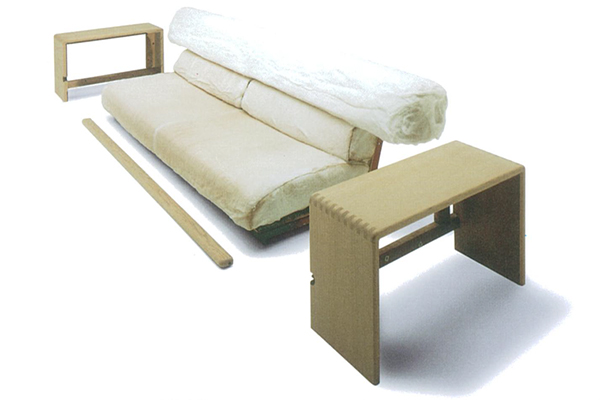
The return of the wounded warrior
In our factory, there is a special kind of excitement when an old, battered piece of furniture returns to us. Recently, a “BOLS” sofa—one of our long-selling icons—came home after several decades of service.
When we stripped away the worn-out nubuck leather, we found the internal cushions looking like a battlefield. The foam had lost its spirit, and the leather was stained with the history of a thousand Sunday afternoons. To most people, it was “trash.” To us, it was a “Wounded Warrior” returning from the front lines of a customer’s life.

The art of the “meaningful scar”
Here is where the “surgery” gets complicated. Restoration is actually much harder than making a new sofa from scratch. Why? Because our craftsmen have to play the role of psychologists. They have to decide: How much of the “old” should we keep?
It’s easy to make a wooden frame look brand-new. But those scratches and stains on the armrests are more than just damage—they are stories. They are the marks of a child growing up or a cat finding its favorite spot. If we erase them all, we erase the family’s history.
For this BOLS sofa, we decided to keep the original frame and its “ambiance” but replaced the old cotton-wrapped foam with modern, resilient molded urethane. We gave it new life, but we made sure it kept its soul. We don’t want the customer to say, “Nice to meet you.” We want them to say, “Welcome back.”

The “unprofitable” truth
Now, let me share a secret from the management side: Restoration is not a good way to make a profit in the short term. Unlike our modern production lines, restoration cannot be streamlined. No two “wounds” are the same. We have to examine every inch, carefully strip coatings by hand, and debate the best approach for each individual piece. It’s slow, it’s labor-intensive, and it’s completely inefficient.
So why do we do it? First, because we respect the wood. These trees took decades to grow; we owe it to them to make their “afterlife” as a chair last just as long. Second, because of that moment of delivery. When a customer sees their old friend returned to them, restored but still familiar, that look on their face is a currency that doesn’t show up on a balance sheet.
And let me be clear: I am not just saying this to sound like a “nice guy.” This is a calculated management decision for long-term success. People who experience this level of care become our most passionate supporters, promoting our furniture through powerful word-of-mouth. In fact, we often see the children of these customers, who grew up with our furniture, coming back to buy their own pieces when they start their own families. They choose us because we’ve been part of their home for as long as they can remember.
I’m the kind of person who worries about the end of the world (as you know from my I Am Legend obsession), so seeing things that actually last—and relationships that span generations—gives me a rare sense of peace.
I confess that I love the ‘inefficiency’ of restoration—because a balance sheet can never capture the magic of an old friend coming home. At CondeHouse, we don’t just sell furniture; we start a relationship that is meant to outlast us. Our Hatsune Miku Art Chair is no exception. It is built with the same ‘unprofitable’ dedication as our long-selling icons, designed to be a vibrant part of your life today and a ‘Wounded Warrior’ that we will proudly heal for you decades from now. It is a masterpiece that respects the wood’s past and promises you a future of ‘Welcome backs.’ Now, here is a portal to a legacy you can start today: the image below is your link to the special site. If you prefer the disposable, ‘use-it-and-lose-it’ products of the modern world, do NOT click it. But if you’re ready to own a story that will stay in your family for generations, go ahead. Start the journey. —— The Hatsune Miku Art Chair.


Shungo Ijima
Global Connector | Reformed Bureaucrat | Professional Over-Thinker
After years of navigating the rigid hallways of Japan’s Ministry of Finance and surviving an MBA, he made a life-changing realization: spreadsheets are soulless, and wood has much better stories to tell.
Currently an Executive at CondeHouse, he travels the world decoding the “hidden DNA” of Japanese culture—though, in his travels, he’s becoming increasingly more skilled at decoding how to find the cheapest hotels than actual cultural mysteries.
He has a peculiar talent for finding deep philosophical meaning in things most people ignore as meaningless (and to be fair, they are often actually meaningless). He doesn’t just sell furniture; he’s on a mission to explain Japan to the world, one intellectually over-analyzed observation at a time. He writes for the curious, the skeptical, and anyone who suspects that a chair might actually be a manifesto in disguise.
Follow his journey as he bridges the gap between high-finance logic and the chaotic art of living!