

The end of summer: A necessary physical overload
In Japan, fireworks festivals (hanabi taikai) traditionally signal the emotional conclusion of summer. After two years of cancellations due to COVID, they roared back in 2022. I attended the largest one in Hokkaido, where over 20,000 fireworks are launched for an annual crowd of 200,000.
What I saw there vividly demonstrated the absolute limits of online activity: the necessity of the actual, physical experience. There were teenagers awkwardly smiling at each other (having not met face-to-face all summer), kids running and yelling in pure, unfiltered excitement, and parents attempting to scold them amidst the noise. These were the chaotic, messy, profoundly real Japanese summer scenes I hadn’t realized I missed until I was back in the crowd.
The physics of pleasure: The soundwave that cannot be streamed
Speaking of things that cannot be replicated online, consider the sound wave of the fireworks. I intentionally positioned myself close to the launch site to enjoy not just the colors, but the shock wave that resonated deep in my internal organs. Fireworks are not just to be watched; they are to be felt—an assault of light and sound that fully engages the physical body.
Among the 20,000 launched fireworks, one unique pyrotechnic innovation absolutely blew my mind. It was a new design called “Sliding Peony”. My vocabulary is too poor to describe its singular beauty. Instead, please watch these YouTube videos below (of similar designs) to grasp the innovation.
The innovation engine: Competition for craftsmanship
The high regard for Japanese fireworks technology internationally is no accident. It is fueled by fierce, formalized competition.
The All Japan Fireworks Competition in Akita Prefecture (one of Japan’s “Big Three” festivals) serves as an engine for innovation. Craftspeople gather to compete and push the absolute limits of pyrotechnic design. This is the pressurized environment that continually yields innovations like the “Sliding Peony.”
The same principle of competitive pressure driving innovation is vital in our industry.
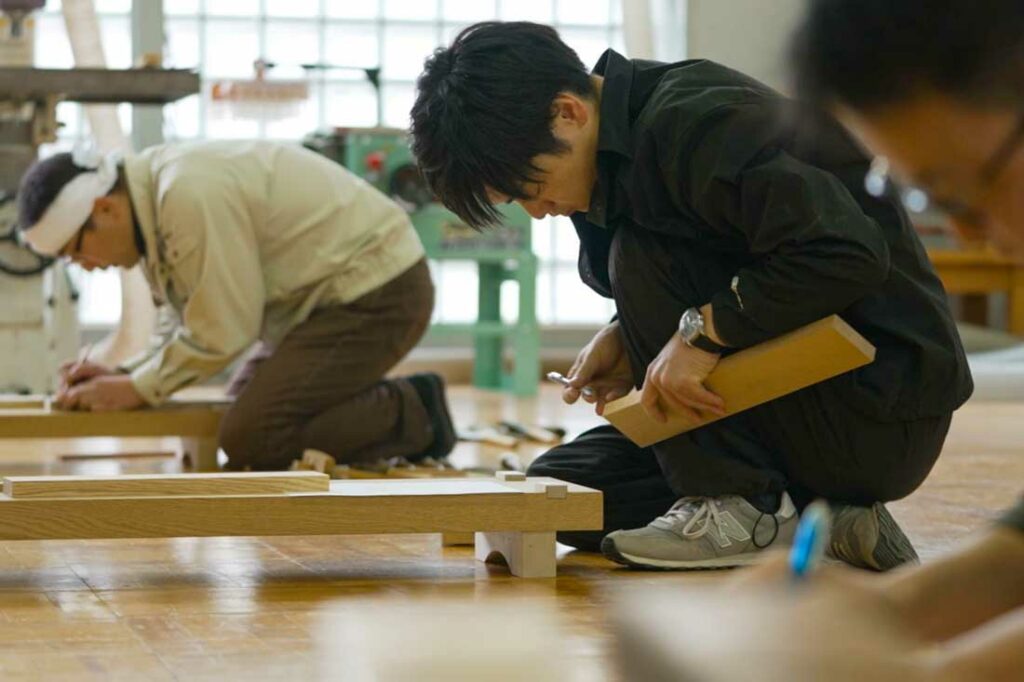
This June, we held the Asahikawa Woodworking Skills Competition. Though recently established, the level was immediately high, with many participants being former Japanese representatives for the WorldSkills Competition. We are committed to continuing this competition annually, creating a demanding standard that ensures the improvement and inheritance of woodworking skills.
We encourage you to seek out experiences that assault your senses and remind you of the essential physicality of life, whether that is the shockwave of a Japanese firework or the perfect tactile smoothness of a piece of expertly finished furniture. We look forward to your entry to our competition, even from outside of Japan!
I confess that I missed the visceral, organ-shaking roar of fireworks more than I realized—because no matter how much our lives move online, we crave the physical ‘shockwave’ that only reality can provide. At CondeHouse, we treat woodworking as a high-stakes competition, pushing our craftspeople to create furniture that hits you with the same sensory impact as a ‘Sliding Peony’ exploding in the night sky. Our Hatsune Miku Art Chair is that explosion—a masterpiece of turquoise-green light and Hokkaido-hardwood soul that you don’t just look at; you feel it in your very core. Now, here is a portal to an experience that cannot be streamed: the image below is your link to the special site. If you prefer the quiet, flat safety of a digital-only existence, do NOT click it. But if you’re ready for a physical encounter that will assault your senses in the best way possible, go ahead. Feel the resonance. —— The Hatsune Miku Art Chair.


Shungo Ijima
Global Connector | Reformed Bureaucrat | Professional Over-Thinker
After years of navigating the rigid hallways of Japan’s Ministry of Finance and surviving an MBA, he made a life-changing realization: spreadsheets are soulless, and wood has much better stories to tell.
Currently an Executive at CondeHouse, he travels the world decoding the “hidden DNA” of Japanese culture—though, in his travels, he’s becoming increasingly more skilled at decoding how to find the cheapest hotels than actual cultural mysteries.
He has a peculiar talent for finding deep philosophical meaning in things most people ignore as meaningless (and to be fair, they are often actually meaningless). He doesn’t just sell furniture; he’s on a mission to explain Japan to the world, one intellectually over-analyzed observation at a time. He writes for the curious, the skeptical, and anyone who suspects that a chair might actually be a manifesto in disguise.
Follow his journey as he bridges the gap between high-finance logic and the chaotic art of living!