
The surveillance culture: Why I came back to the office against the times
Do we still need an office? This discussion is livelier than ever since remote work became common due to COVID-19. Proponents of working from home argue convincingly for its benefits: improved productivity through concentration, and reduced stress from office relationships.
Prior to COVID, my job involved constant business trips, meaning I was rarely in the office. It’s a truly human paradox that, I used to work almost entirely remotely, but now I’m back here in the office, completely against the grain of the current trend.
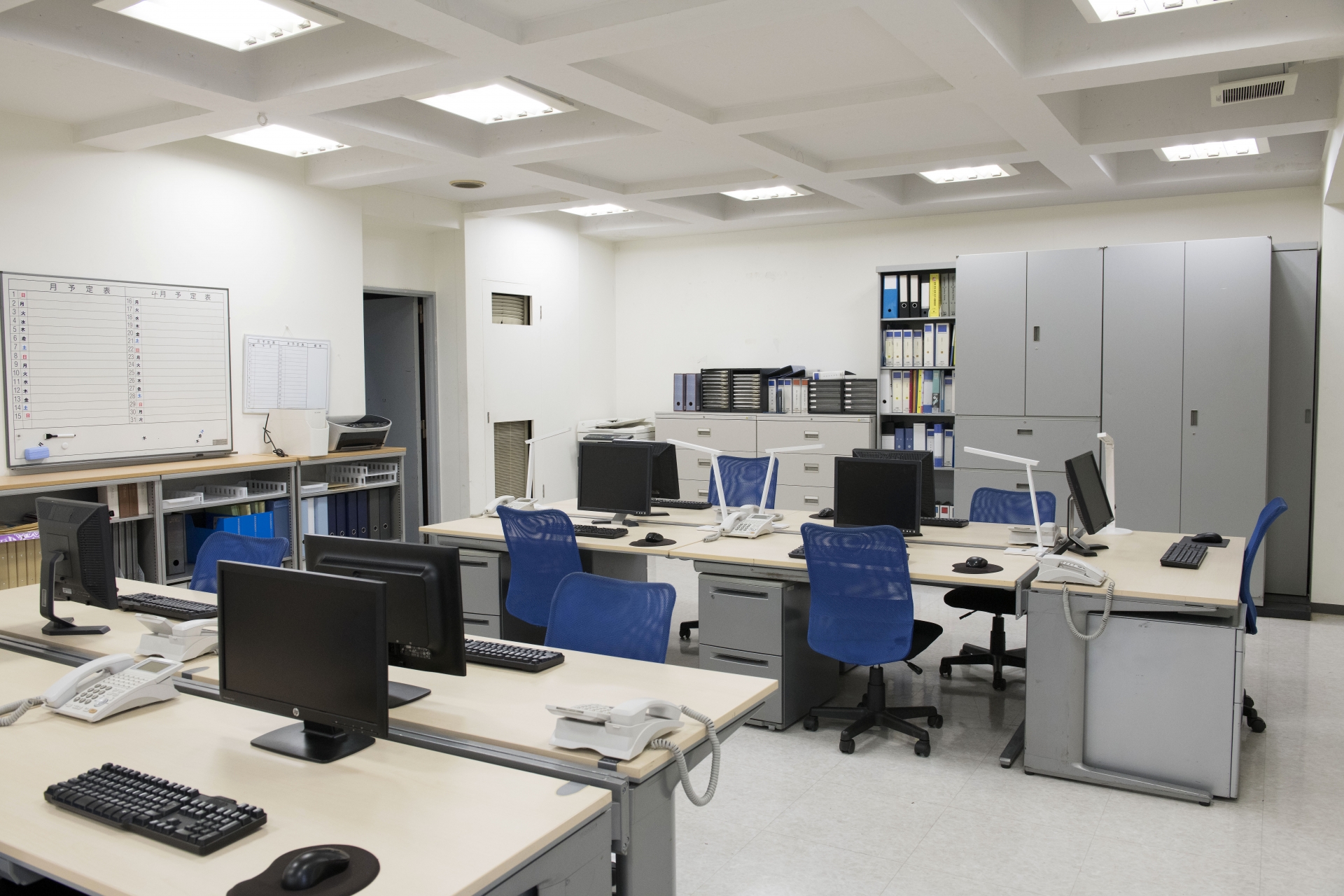
Let’s first understand the basic layout of a typical Japanese office. Customarily, desks are arranged in confrontational rows, with executive desks closely facing their team members. Private rooms are extremely rare. In large corporations, some of these department heads are rumored to be waiting quietly for retirement rather than working—earning them the nickname “Windows 2000”: they sit by the window, and they cost about 20 million yen a year.
This arrangement is rooted in the deep-seated Japanese value of “Wa” (harmony), requiring visual confirmation of everyone’s efforts. To put it politely, it’s an open-space community; to put it realistically (from my viewpoint), it’s a prison under mutual surveillance.
In Japan, we also call it “Teamwork.” I call it an “Inquisitorial Chamber” where the high-context pressure to look busy is more important than actually being productive. It’s a theater of effort, not a factory of ideas.
The death of the “Minute”: The most annoying question in Japanese offices
This is where the Japanese office environment becomes a productivity black hole. The phone is ringing constantly somewhere; people are talking loudly around your desk; and then, someone approaches you, throwing out the most meaningless question in the world: “Do you have a minute? (Ima, chotto ii desu ka?)”
I want to scream this out loud: What is the point of that question?
That conversation rarely, if ever, ends in a single minute. Furthermore, by initiating the question, the person is forcing you to make an immediate cognitive shift—moving your brain from deep work to social judgment—before the actual work request even begins. It’s a courtesy that acts as a profound act of aggression against focus. This incessant stream of noise and interruption, framed by forced politeness, is the biggest barrier to productivity in this environment.
Fighting the loneliness disease: The value of flexible design
Having complained extensively about working in the office, I should confess I didn’t mean to deny its value completely. The truth is, the period of COVID made me keenly aware of the importance of human connection. Loneliness is a deadly disease. And I don’t mean that metaphorically: a large-scale meta-analysis found that weak social connections are associated with a roughly 50% increase in mortality risk—an effect in the same league as smoking and obesity.
The irony, of course, is that being around people is stressful too. Office politics raises cortisol; solitude raises mortality statistics. Apparently, simply being alive is hazardous to our health. The only reasonable response, then, is not total isolation nor constant proximity, but a deliberate balance. Perhaps that is why we still need the office—not as a prison of mutual surveillance, but as a carefully calibrated dose of humanity.
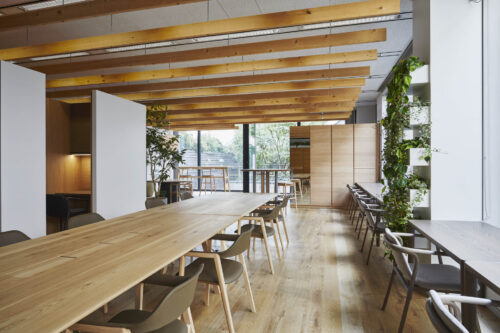
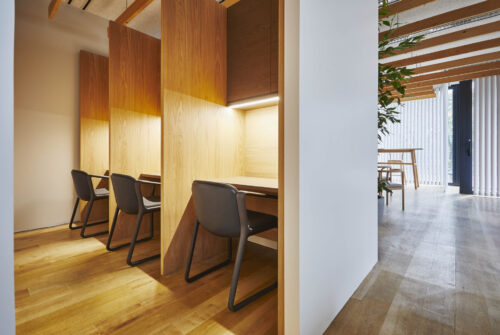
However, maintaining a reasonable distance between colleagues is equally vital for a good environment. This is why I attempted a “Cognitive Sabotage” against the traditional layout in our Tokyo office. It’s not just an interior design; it’s a tool for mental survival. (I call it the “Sanctuary for the Socially Exhausted”.)
The images above are of our Tokyo office. My favorite part is its diversity. You can be alone and deeply absorb yourself in something in the semi-private, partitioned areas. Conversely, you can communicate closely with colleagues in the open areas when you’re feeling lonely to death. This flexible design allows the individual to choose the right setting for their task and emotional state. This, I sincerely hope, will be the new standard for Japanese offices.
The Hokkaido reality: Seeking strategic escape
The problem? The headquarters office where I currently work—here in Hokkaido—remains a classic “Windows 2000” habitat: confronting desks and relentless “Do you have a minute?” interruptions.
As someone who has embraced the organization theory of the “Lazy Ant,” I realize the critical need for “slack time” and undistracted deep work. In an environment that demands constant presence, the only strategic solution is a “Strategic Absence.” Perhaps I need to ask our sales team for a ticket to Tokyo. Not for a meeting, but for my own psychological resilience. (Ah, the excuses we make to protect our focus!)
Have you spotted a “Windows 2000” in your office, or are you currently battling the “Do You Have a Minute?” brigade? Share your survival stories in the comments or repost this to save a fellow focus-seeker.
[ The Art of “Productive Absence” ]
To survive this “Harmony Prison,” I had to develop my own method of psychological escape. I have detailed my “Lazy Ant Survival Guide”—the raw reality of my battle for focus in a traditional 57-year-old company—in a private 4-page column.
If you are fighting your own battle against the “Minute Brigade,” this guide is for you.

Shungo Ijima
Global Connector | Reformed Bureaucrat | Professional Over-Thinker
After years of navigating the rigid hallways of Japan’s Ministry of Finance and surviving an MBA, he made a life-changing realization: spreadsheets are soulless, and wood has much better stories to tell.
Currently an Executive at CondeHouse, he travels the world decoding the “hidden DNA” of Japanese culture—though, in his travels, he’s becoming increasingly more skilled at decoding how to find the cheapest hotels than actual cultural mysteries.
He has a peculiar talent for finding deep philosophical meaning in things most people ignore as meaningless (and to be fair, they are often actually meaningless). He doesn’t just sell furniture; he’s on a mission to explain Japan to the world, one intellectually over-analyzed observation at a time. He writes for the curious, the skeptical, and anyone who suspects that a chair might actually be a manifesto in disguise.
Follow his journey as he bridges the gap between high-finance logic and the chaotic art of living!