
The lure of fishing: Why bait is better than Brad Pitt
The 1992 film A River Runs Through It made Brad Pitt a star, ignited the popularity of fly fishing, and left a strong impression on me. I’ve always wanted to try fly fishing—the rod whipping smoothly, the line sparkling as it describes an arc in the air. It’s a beautiful, almost balletic activity, completely different from what I always do.
What I always do is ordinary bait fishing: just wandering along rivers and casting bait. Why don’t I switch to the graceful art of fly fishing? That’s simple math: Bait fishing is easier and catches more fish.
I knowingly quoted Hemingway in a past article: “When you can’t catch fish, think it gave you time to think about life.” I must confess I just pretended to be cool; to tell the truth, I hate to get skunked (go home empty-handed). This reveals the core of my human ego: I prefer assured success over aesthetic pursuit.
The salmon homecoming: From city carcass to eastern outskirts
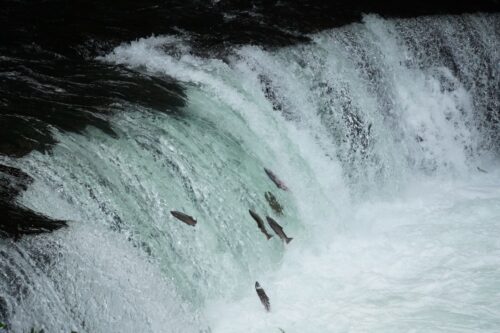
Today, I’m introducing the charm of Hokkaido through the story of fish. Among river fish in Japan, the undisputed king is the salmon. You can see them in many rivers across Hokkaido this season.
In autumn, salmon return from the sea and die in their home river soon after spawning. When I lived in Sapporo, the capital city with a population of two million, I often saw salmon carcasses on the river shore. Since then, I’ve longed to see them swimming alive in the river. Last weekend, I finally went to a small town in the eastern outskirts of Hokkaido, famous as one of the starting points of the salmon homecoming.
My hotel was at the mouth of the river, and luckily, my room was river view on the 7th floor. I went to the window, not expecting much. To my complete surprise, I could see schools of salmon swimming vividly in the river even from the 7th floor! The river flow was slow at the estuary, and the surface waves made by the dense schools of salmon were clearly visible—so many that even the seagulls on the water looked annoyed.
The grand exchange: Salmon as the ocean’s gift to the forest
The life cycle of the salmon is astounding: it takes about one month for the juvenile to go down to the sea, and it returns to its home river after two to five years. The average size of a juvenile is about 20 mm and 0.4 g; the adult is about 80 cm and 8 kg. That’s a fortyfold increase in length and a 20,000-fold increase in weight.
Nature is impeccably designed. The grown salmon are supposed to die soon after spawning, and forest animals like bears and foxes readily eat the salmon carcasses. In other words, salmon brings a vast amount of nutrients from the sea back to the rivers and forests.
In that profound sense, it is not an exaggeration to say that our Hokkaido wooden furniture is actually made from salmon. The trees that supply our wood are fed by the bounty of the ocean, delivered inland by the ultimate sacrifice of the king of the rivers.
The human paradox: The joy of eating the roe
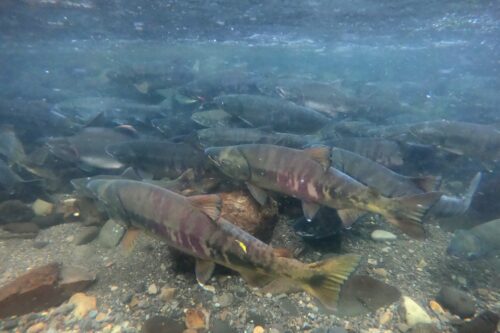
Salmon running up the river is truly the charm of Hokkaido in autumn. Hokkaido is the home of salmon in Japan, and this is why you can enjoy incredibly fresh salmon roe (Ikura) everywhere.
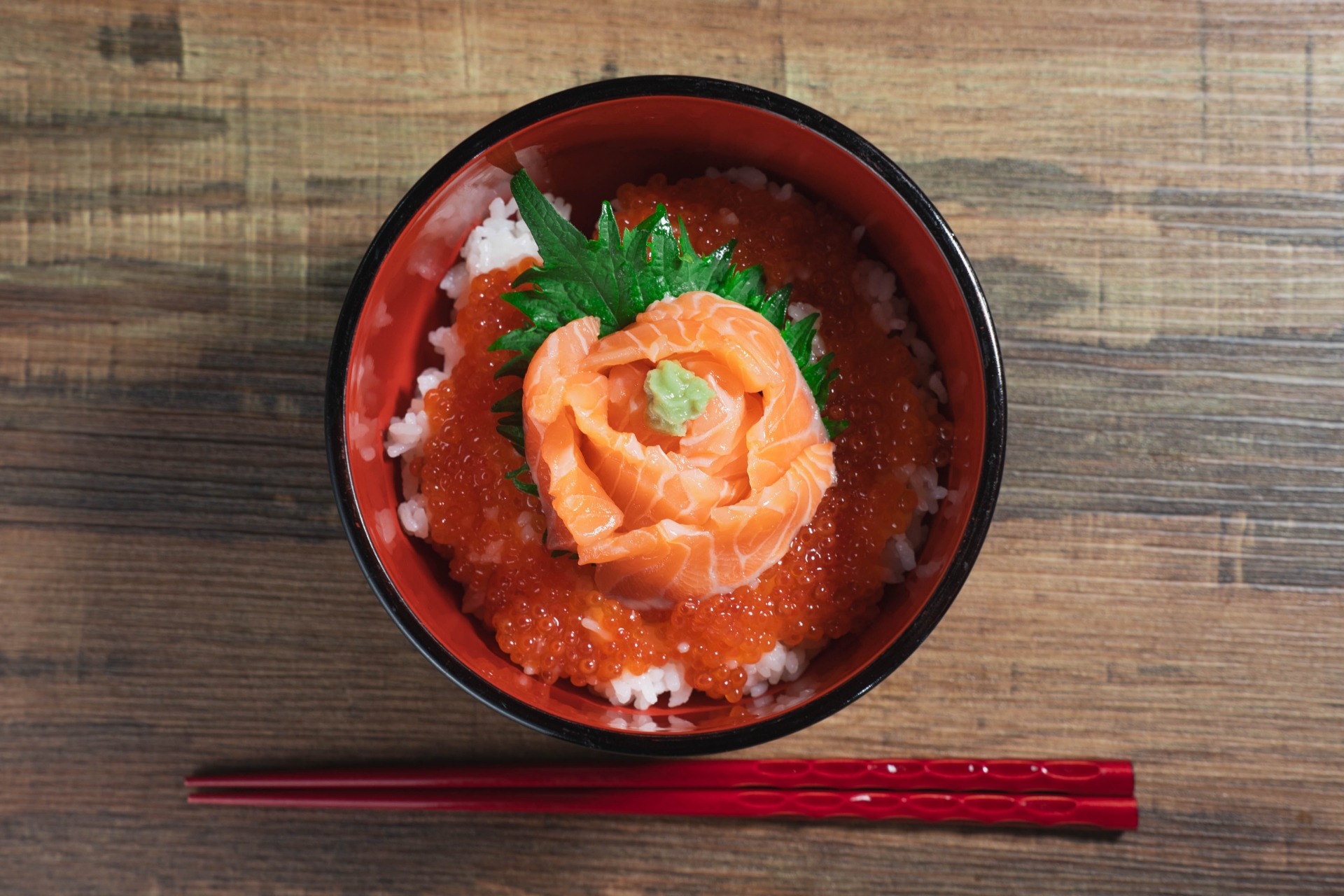
Herein lies the profound paradox and the final, amusing human twist: After witnessing this spectacular, life-and-death cycle of homecoming and sacrifice, you may hesitate to eat the salmon roe—the eggs that represent the future of the species. Yet, it is precisely because of this abundance and unique ecosystem that we have the chance to savor the freshest, most delicious Ikura in the world. It is the ultimate act of human appreciation (and consumption) of the grand ecological cycle.
Do you feel like coming to Hokkaido? Oh, mind you, it is prohibited by law to fish salmon in the river. So, you’ll have to settle for enjoying the beautiful sight—and eating the deliciously inevitable roe.
I may pretend to be a cool philosopher, quoting Hemingway while staring at a river, but the truth is far less poetic: I am a man who chooses bait over balletic fly-casting because I simply cannot stand the thought of going home without a catch. I watched those schools of salmon—the kings of the river—sacrificing everything to feed the forest, and while my brain was busy admiring the ‘grand cycle of life,’ my stomach was busy calculating the market price of Ikura. But this human greed is, perhaps, just another form of appreciation. If, as I claim, our furniture is ‘made from salmon’ because the trees are fed by the bounty of the sea, then our Hatsune Miku Art Chair is the ultimate homecoming. We’ve taken the timber nurtured by that oceanic sacrifice and refined it with the same ‘bait-fishing’ pragmatism: why settle for a boring stool when you can have a masterpiece? It is a chair built from the nutrients of the deep and the soul of the north—a piece of art that, unlike a salmon, will never wither on a riverbank. Come to Hokkaido, admire the spectacle, eat the roe, and then sit in the only chair that turns the ‘ocean’s gift’ into a digital sanctuary. —— The Hatsune Miku Art Chair.


Shungo Ijima
Global Connector | Reformed Bureaucrat | Professional Over-Thinker
After years of navigating the rigid hallways of Japan’s Ministry of Finance and surviving an MBA, he made a life-changing realization: spreadsheets are soulless, and wood has much better stories to tell.
Currently an Executive at CondeHouse, he travels the world decoding the “hidden DNA” of Japanese culture—though, in his travels, he’s becoming increasingly more skilled at decoding how to find the cheapest hotels than actual cultural mysteries.
He has a peculiar talent for finding deep philosophical meaning in things most people ignore as meaningless (and to be fair, they are often actually meaningless). He doesn’t just sell furniture; he’s on a mission to explain Japan to the world, one intellectually over-analyzed observation at a time. He writes for the curious, the skeptical, and anyone who suspects that a chair might actually be a manifesto in disguise.
Follow his journey as he bridges the gap between high-finance logic and the chaotic art of living!