
The national curse: Detail obsession and the G7 ranking
It’s often futile to generalize national characteristics, but I can’t help myself: we Japanese are pathologically detail-oriented. We care too much about the small issues. And I am willing to bet this obsession is a major cause of our chronically low labor productivity—a statistic that has placed Japan last among G7 countries for the past 50 years. We are sacrificing the forest for the millimeter.
But don’t worry, I’m not here to solve our national economic structure. I’m here to share how this deeply ingrained, neurotic national trait influences everything, even the display of confiscated criminal evidence.
The fentanyl paradox: Canadian vs. Japanese police exhibits

I used to be a customs officer. My bosses gave incredibly detailed instructions on how to display confiscated contraband—guns, drugs, counterfeit goods—making sure everything was neat and tidy. I assumed this was standard police protocol everywhere until I realized it wasn’t. The national character, it turns out, is visible even in criminal exhibits.
Look at the contrast above. Do you notice the difference? On the Japanese side, the seized items—perhaps stolen baseballs, for instance—are often placed with the seams facing the same way, or the drug packets lined up with obsessive precision. No offense to my Canadian friends, but the exhibit by the Japanese police is a masterpiece of neurotic organization. The Japanese criminal display is a museum piece; the Canadian one is just evidence.
This is not about efficiency or legal necessity; it’s about an ingrained cultural need for order. We must perfect the details, even if the details are bags of fentanyl.
The proof of quality: Tools as art
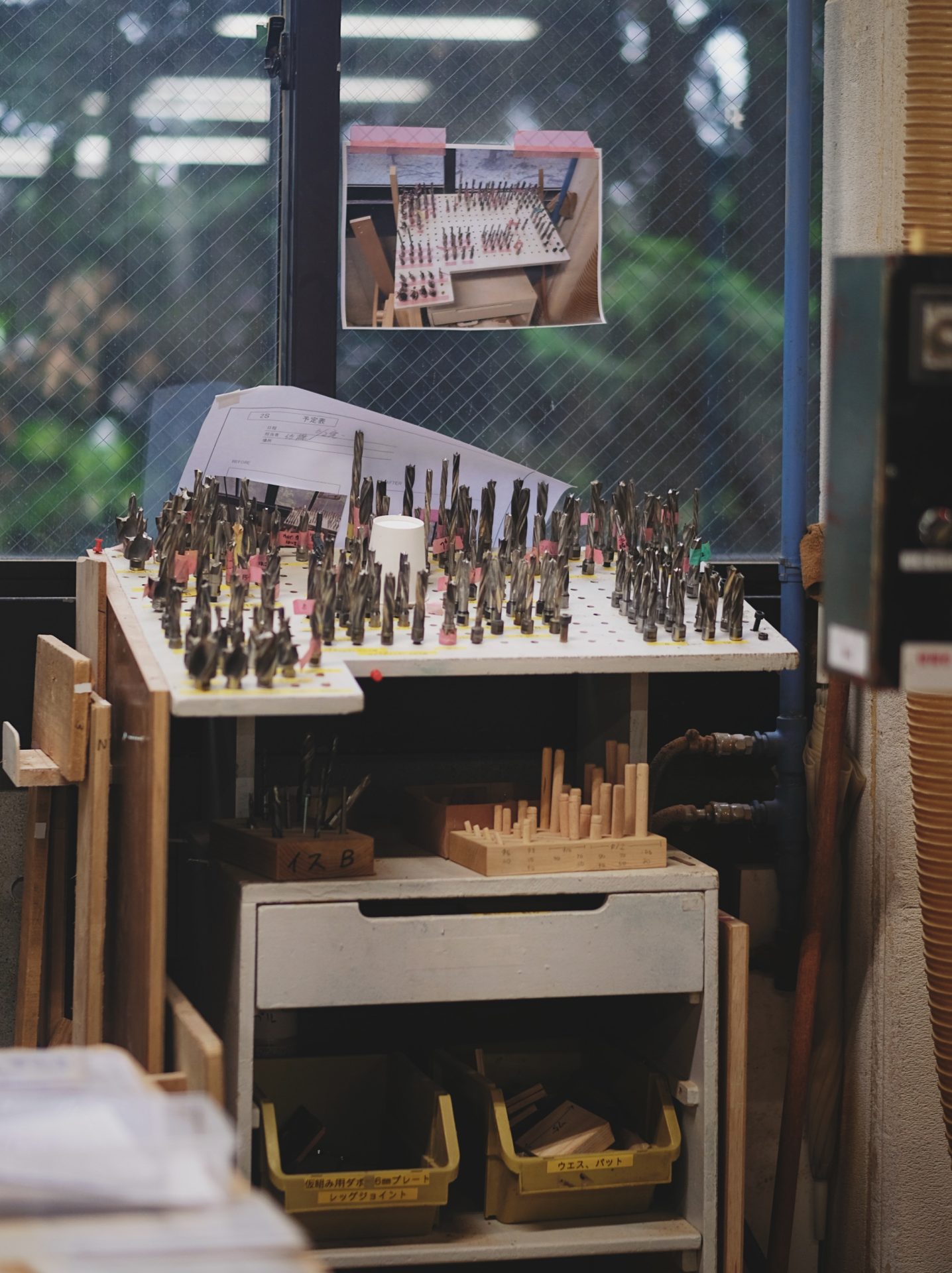
This obsession with minutiae translates directly to our craft. We give factory tours, and the most unexpected attraction for foreign visitors is not the furniture itself, but the tools. I often see overseas guests eagerly taking pictures of the tools neatly aligned on the walls or shelves. Some even declare: “This is the proof of quality!”
Japanese visitors, however, pay no attention. To them, the perfectly aligned tool rack is simply the standard state of the world.
Yes, this detail-oriented nature might be a factor in our low productivity. But here is the critical exception: in manufacturing where perfection of execution is the product—like high-end wooden furniture—this neurotic trait is our greatest asset. Taking these small, obsessive steps is precisely what allows us to realize the high-quality, durable furniture we promise.
When we resume factory tours after the COVID dust settles, I look forward to seeing the awe in your eyes as you gaze upon our perfectly organized tool racks. You won’t just be looking at tools; you’ll be looking at the hidden, pathological cost of quality.
I confess that I once obsessed over aligning drug seizures with museum-level precision—a neurotic Japanese trait that might kill our GDP, but breathes life into our furniture. In Japan, we don’t just ‘make’ things; we align every fiber and grain until the order is absolute. Our Hatsune Miku Art Chair is the ultimate manifestation of this pathology: a masterpiece where digital precision meets a physical obsession so deep, it makes confiscated fentanyl look messy. It’s not just a chair; it’s a tool rack of high-art, perfectly aligned for your comfort. Now, here is a doorway to our beautifully organized madness: the image below is your link to the special site. If you prefer the chaotic, ‘productive’ reality of the ordinary, do NOT click it. But if you’re ready to see the hidden cost of perfection, go ahead. Discover our neurotic soul. —— The Hatsune Miku Art Chair.


Shungo Ijima
Global Connector | Reformed Bureaucrat | Professional Over-Thinker
After years of navigating the rigid hallways of Japan’s Ministry of Finance and surviving an MBA, he made a life-changing realization: spreadsheets are soulless, and wood has much better stories to tell.
Currently an Executive at CondeHouse, he travels the world decoding the “hidden DNA” of Japanese culture—though, in his travels, he’s becoming increasingly more skilled at decoding how to find the cheapest hotels than actual cultural mysteries.
He has a peculiar talent for finding deep philosophical meaning in things most people ignore as meaningless (and to be fair, they are often actually meaningless). He doesn’t just sell furniture; he’s on a mission to explain Japan to the world, one intellectually over-analyzed observation at a time. He writes for the curious, the skeptical, and anyone who suspects that a chair might actually be a manifesto in disguise.
Follow his journey as he bridges the gap between high-finance logic and the chaotic art of living!