
The national shame: A 30-Year lifespan (and the mystery of the deer feces)
As I’ve written elsewhere in this blog, we in Hokkaido are struggling with a severe problem of deer overpopulation. In contrast, Japan’s ancient capital, Nara City, seems to coexist successfully with deer. Nara Park is home to over 1,000 deer that tourists can freely feed. Every time I see this, one burning question comes to my mind: Who cleans up all the feces?
I just looked it up, and the answer is surprisingly elegant: specific bugs decompose them almost immediately, within a night or two. So, no need to worry about stepping on deer droppings. This little biological miracle highlights a very Japanese talent: coexisting with nature in a seemingly chaotic, yet highly ordered, manner.
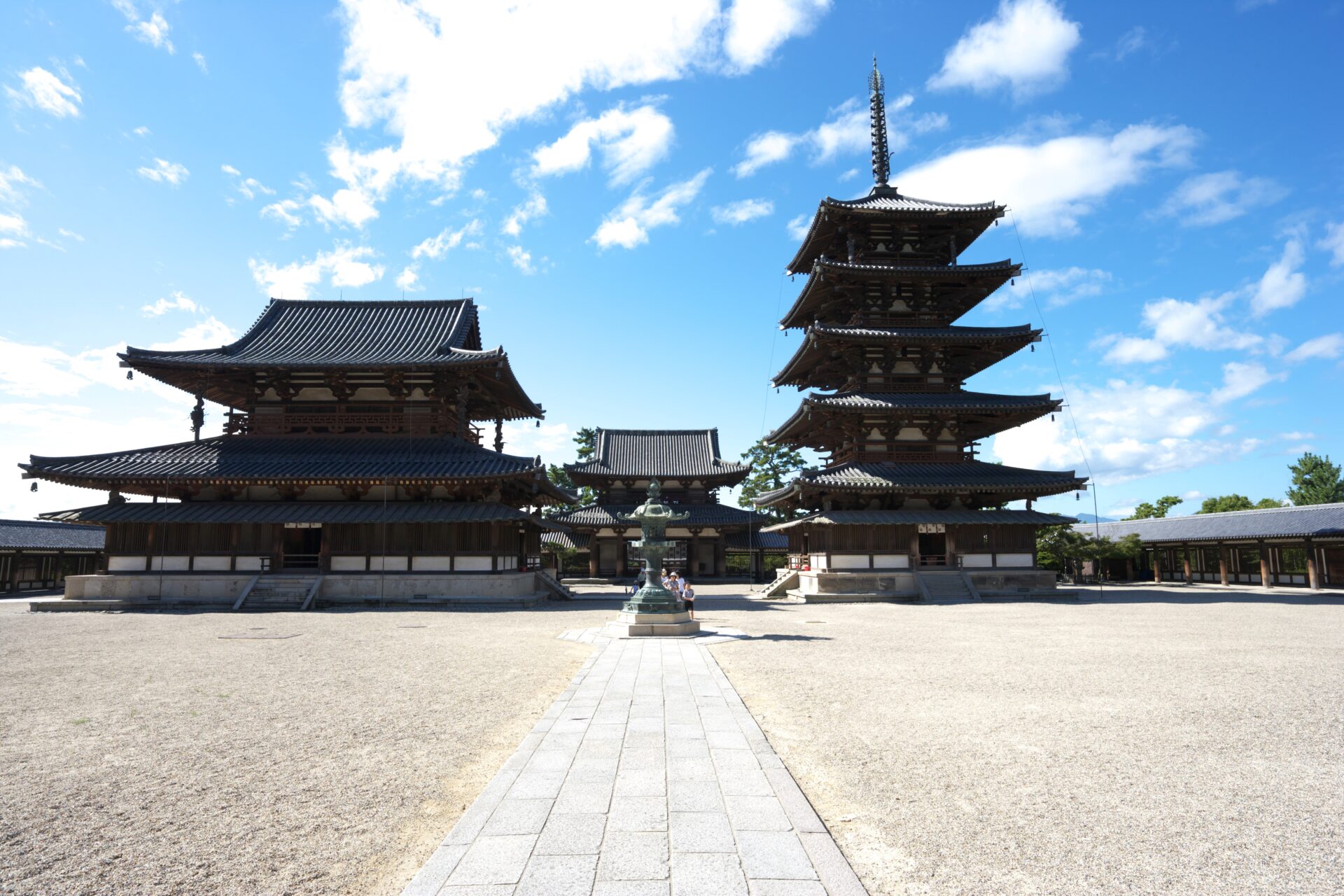
This seamless coexistence takes place in Nara Prefecture, home to the Hōryū-ji Temple (see image above), registered as a UNESCO World Cultural Heritage site. Did you know this is the world’s oldest wooden building? It was built in 607 AD, surviving nearly 1,400 years in Japan, the undisputed “country of earthquakes.”
Now, consider this deeply embarrassing statistic: the average lifespan of a modern Japanese residential building is only about 30 years. That is shockingly short compared to the US (around 100 years) and the UK (around 150 years). We are masters of long-term planning, yet our homes are built with the durability of a rental apartment.
Why does Hōryū-ji endure while our modern houses crumble?
The secret of flexibility: An ancient engineering miracle
The endurance of these ancient temples rests on two fundamental pillars.
The first is its genius, earthquake-proof structure. Researchers were stunned to discover that the building frames were designed with flexible joints—not rigid ones—to effectively reduce the shaking force during an earthquake. This advanced structural thinking, built on the principle of yielding rather than resisting, existed 1,400 years ago. It’s a powerful metaphor: ultimate strength comes not from rigidity, but from the ability to flex and absorb shock.
The second pillar, often overlooked, is continuous maintenance. Ancient temples were built with the clear premise that they would be maintained regularly. It was a social rule that the specific carpenters responsible for the daily maintenance of a temple or shrine lived in the adjacent area, ensuring generational, daily care.
The paradox of modern durability: Our furniture vs. our homes
Most Japanese residential buildings today were rapidly constructed after World War II, prioritizing speed and cost for a devastated nation. These quickly-built houses were structurally weak, and the prevailing modern assumption is that a house is only meant to last one generation. Consequently, people do not maintain them seriously.
Here lies the paradox that affects our industry: the lifetime of our furniture often exceeds that of the house it sits in.
We sometimes receive messages from customers telling us they are handing down our furniture to the next generation. That is the highest possible honor for us. The lesson from Hōryū-ji is clear: long life is not a result of materials alone, but of a commitment to continuous care.
If a 1,400-year-old wooden structure can survive Japan’s earthquakes, our modern houses have no excuse. Perhaps we should return to the mindset of the ancient carpenter, building and designing with the belief that everything—from a temple to a chair—is worthy of generational maintenance and care.
I confess that I’m embarrassed by the 30-year lifespan of modern Japanese houses, especially when our 1,400-year-old temples prove that wood can outlast empires if it knows how to flex. At CondeHouse, we build with that ancient wisdom: creating furniture designed to outlive the very walls that surround it. Our Hatsune Miku Art Chair is a modern Hōryū-ji—a structural miracle of flexibility and turquoise-green elegance, crafted for generational care. It’s not a disposable object; it’s a legacy that waits to be handed down. Now, here is a portal to our most enduring craft: the image below is your link to the special site. If you prefer the fragile, short-lived convenience of the ordinary, do NOT click it. But if you’re ready to invest in a masterpiece that understands the secret of 1,400-year endurance, go ahead. Step into history. —— The Hatsune Miku Art Chair.

Photo credit: http://www.yunphoto.net

Shungo Ijima
Global Connector | Reformed Bureaucrat | Professional Over-Thinker
After years of navigating the rigid hallways of Japan’s Ministry of Finance and surviving an MBA, he made a life-changing realization: spreadsheets are soulless, and wood has much better stories to tell.
Currently an Executive at CondeHouse, he travels the world decoding the “hidden DNA” of Japanese culture—though, in his travels, he’s becoming increasingly more skilled at decoding how to find the cheapest hotels than actual cultural mysteries.
He has a peculiar talent for finding deep philosophical meaning in things most people ignore as meaningless (and to be fair, they are often actually meaningless). He doesn’t just sell furniture; he’s on a mission to explain Japan to the world, one intellectually over-analyzed observation at a time. He writes for the curious, the skeptical, and anyone who suspects that a chair might actually be a manifesto in disguise.
Follow his journey as he bridges the gap between high-finance logic and the chaotic art of living!
Comments
List of comments (1)
[…] people (even Japanese people) still believe that Japanese old buildings, like temples and shrines built several hundred years ago, didn’t use any nails, but actually […]