
The leather paradox: From the coachman’s seat to my aching shoulders
We generally associate leather with luxury, don’t we? I remember the first time I bought a genuine leather coat—I felt an immediate, if illusory, surge in my social status. I was convinced I looked like a man who had “arrived.”
But today? My criteria for coats and bags have shifted from “status” to “survival.” My primary requirement is lightness. I will likely never buy heavy leather again, simply because my shoulders can no longer bear the weight of my own vanity. I’m reminded of Miranda Priestly in “The Devil Wears Prada,” who, in a rare moment of vulnerability, remarked on her life at the top of the fashion world: “I don’t have a choice. This is my life.” I feel a kinship with Miranda; thanks to my chronic shoulder stiffness, I, too, have no choice but to abandon leather.
Ironically, history has done a complete 180-degree flip. Once upon a time, when the nobility traveled by horse carriage, leather was reserved for the coachman’s seat outside (to withstand the rain), while the fine, delicate fabric was kept for the passengers inside. Now, in the age of the supercar, leather is the standard for “luxury.” But there is a new contender that challenges this hierarchy.
The Italian soul with a Japanese heart
In this current landscape, I believe the only viable alternative to genuine leather is Alcantara. Car enthusiasts, especially Ferrari fans, covet it intensely. Alcantara has become a synonym for luxury artificial suede, but it is actually the name of a prestigious Italian company.
Here is a point of national pride: Alcantara S.p.A. is actually a wholly-owned subsidiary of the Japanese chemical giant, TORAY. This world-famous “Italian” material was actually invented by a Japanese scientist. It is the perfect marriage of Italian flair and Japanese material science.
The authenticity of the artificial
Some people recoil at the word “artificial,” but Alcantara’s tactile experience is indistinguishable from the finest real suede. In the world of high-end automotive design, the label “Alcantara” carries as much weight as Ermenegildo Zegna does in the world of bespoke tailoring. It is rare for a material brand to be so prestigious that its name appears alongside the car model itself—think of the “Alcantara Edition” luxury trims.
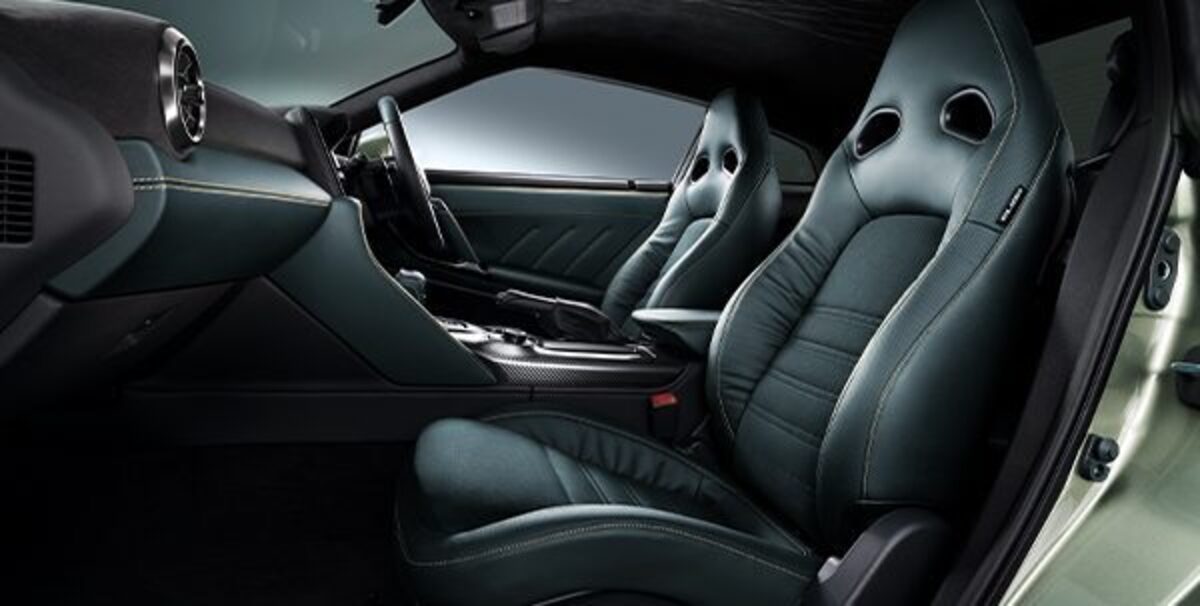
A stunning example is the “GT-R50 by Italdesign,” a masterpiece released to commemorate the 50th anniversary of the Nissan GT-R—Japan’s premier supercar and a holy grail for enthusiasts worldwide. One look at its interior, upholstered entirely in Alcantara, and any debate about “authenticity” vanishes. It is undeniably beautiful, supremely luxurious, and arguably superior to the original.
The ethical edge: Beyond the scarcity of skin
For the intellectual elite, the appeal of Alcantara goes beyond touch—it’s about modern ethics. The production of genuine leather, specifically the tanning process, places a massive burden on our planet. It requires vast amounts of water and often involves heavy metals such as Hexavalent Chromium (CrVI), which can lead to significant soil and water contamination.
In a complex and fragile world, the future of luxury does not lie in scarcity or animal hides, but in conscious creation. Because Alcantara is produced using renewable biomaterials and eco-friendly processes, it offers a “guilt-free” luxury that genuine leather simply cannot match.
From Ferrari seats to your living room: Meet Ultrasuede
Now, for my humble confession: TORAY produces this same miraculous material in Japan under the brand name Ultrasuede.
At CondeHouse, Ultrasuede is one of our most premium fabric collections. While we stock three standard colors for immediate delivery, you can actually choose from over 80 different shades. This gives you a color palette wider than all of our genuine leather collections combined. By choosing Ultrasuede for your chair, you aren’t just buying furniture; you are bringing the seating technology of a Ferrari or a Maserati into your living room—in a way that is customizable, durable, and kind to the Earth.
I may not have a Ferrari parked in my driveway—the Hokkaido snow would likely devour its Italian soul in minutes—and my bank account remains stubbornly resistant to the charms of a Maserati. But I am a man of strategic priorities. I figured that if I can’t afford the engine, I can at least steal the seat.
Our Hatsune Miku Art Chair is upholstered in the very same Ultrasuede that defines the world’s most elite car interiors. It is my ultimate, high-tech “revenge” on the world of supercars: a chair that offers the tactile bliss of an Italdesign GT-R, but with better lumbar support and a much more charming passenger.
Why worry about the speed limit when you can sit in a masterpiece of material science? I’ll keep my humble Hokkaido commuter car for the road, but in my living room, I’m driving a Miku-themed supercar that never needs an oil change.
Experience the pinnacle of Japanese-Italian luxury below: [Click here to explore the Hatsune Miku Art Chair Special Website]

Photo Credit: https://www3.nissan.co.jp/vehicles/new/gt-r/specifications/t-spec.html

Shungo Ijima
Global Connector | Reformed Bureaucrat | Professional Over-Thinker
After years of navigating the rigid hallways of Japan’s Ministry of Finance and surviving an MBA, he made a life-changing realization: spreadsheets are soulless, and wood has much better stories to tell.
Currently an Executive at CondeHouse, he travels the world decoding the “hidden DNA” of Japanese culture—though, in his travels, he’s becoming increasingly more skilled at decoding how to find the cheapest hotels than actual cultural mysteries.
He has a peculiar talent for finding deep philosophical meaning in things most people ignore as meaningless (and to be fair, they are often actually meaningless). He doesn’t just sell furniture; he’s on a mission to explain Japan to the world, one intellectually over-analyzed observation at a time. He writes for the curious, the skeptical, and anyone who suspects that a chair might actually be a manifesto in disguise.
Follow his journey as he bridges the gap between high-finance logic and the chaotic art of living!