

Our carpet DNA: Why Japanese people always end up on the floor
It’s a fact: Japanese people, even figures as prestigious as the Shogun, have been sitting on the floor since ancient times. The chair culture only started to spread here about 150 years ago, a mere blink of an eye in our long history. Even in my childhood, more than 30 years ago, we had a perfectly good couch in the living room. And yet, almost every member of my family, myself included, often ended up on the floor, usually just leaning against that expensive piece of furniture.
Funnier still, our dogs used the couch as their personal, oversized bed. I’m certain this wasn’t just a quirk of my family. When I was hanging out at my friends’ houses, battling it out on Nintendo, they were all doing the exact same thing. I’m starting to believe that this “floor life” is not a mere choice. It might be literally printed in our Japanese DNA—or, more accurately, in our cultural software.
The multi-functionality of tatami: An architectural hack
Of course, I’m kidding about the biology. It’s not an issue of genetics; it’s an issue of architectural wisdom and spatial utilization.
Historically, the average Japanese home has been small, making the no-chair culture a brilliant life hack. We sat on the floor, ate at a low table, and then simply folded the table away to lay out our futons (bedding). This flexibility is rooted in the design of the tatami mat. Tatami is not just a floor covering; it acts as a modular, mobile piece of furniture that regulates humidity and releases a calming scent. It is the technical foundation for a life lived close to the ground.
For people who live down there, the restricted, upright posture of a typical sofa can feel like a cramped cage. When we are at home, we enter a state of ke (the Japanese concept of the ordinary and relaxed), often lying flat on our back or stomach, or sitting with knees held. This freedom is entirely antithetical to the formalized posture expected by a chair, which belongs to the more formal realm of hare (the sacred or ceremonial).
The shoe-free ritual: Separating the inner sanctuary
This state of freedom is only possible because of one of the great advantages of our culture: No shoes inside.
In Japan, the floor is considered clean—a part of the inner sanctuary of the home. The act of removing shoes is not just an etiquette rule; it is a ritualistic act of separating the unclean outside (kegare) from the living space, tracing back to our deep-seated Shinto and agricultural roots.
This makes the cleanliness standards vastly different from Western norms. It’s always an unsettling, yet fascinating, detail for me in Hollywood movies when people hop on the bed with their dirty shoes on. Take the classic movie “Home Alone,” for example. The main character is shown gleefully jumping on his parents’ bed while still wearing his sneakers. To a Japanese person, this extreme disrespect for the bedding and the concept of cleanliness feels almost as destructive as the actual housebreaking robbers he’s defending the house from!
The concept of the “bed throw“—the cloth sometimes seen across a hotel bed, used to prevent dirt from shoes—is genuinely wild to us. The need for a dedicated shield against shoe-dirt on a bed highlights the structural difference in how cultures delineate clean and unclean space. Anyway, even when sitting on a couch, we often subconsciously try to adjust our position in the same way we would on the floor. We feel cramped, we give up, and we simply slide back down to the floor. I believe this is the core reason why we fail to truly relax even on the most comfortable-looking couch.
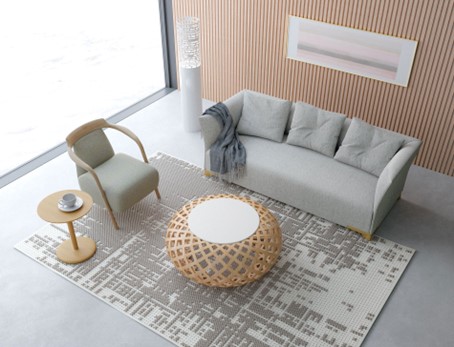
MOLA: Defeating the trap with unrestricted posture
This is a clear problem for a furniture maker like us, and it is our duty to solve this cultural paradox. Our challenge was to design a piece that maintained the freedom of floor-dwelling while providing proper ergonomic support.
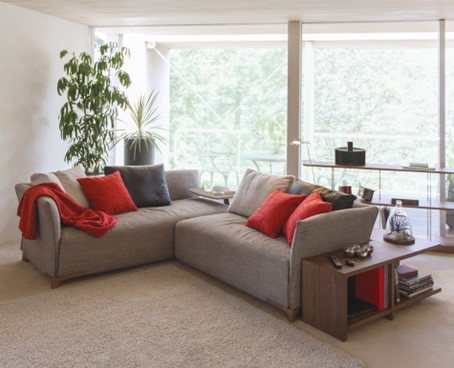
Some years ago, we launched a sofa specifically designed to salvage Japanese people from the floor: MOLA. The designer explained that it was never intended to be “just a sofa” but a “place where people can actually relax.”
We dramatically increased the size, especially the depth, of the seat cushions and made them luxuriously soft by using an abundance of feathers. The goal was to provide a setting that allowed for “Floor Posture Diversity,” accommodating all the sitting, lying, and sprawling postures that relieve cognitive and physical stress. The irregular, modular shape provides an open, inviting space that doesn’t restrict your body. I honestly think it’s something more than a furniture set; it’s more like a personal hideout—the one place you can return to that natural, floor-dwelling freedom, but with the functional support you need.

Shungo Ijima
He is travelling around the world. His passion is to explain Japan to the world, from the unique viewpoint accumulated through his career: overseas posting, MBA holder, former official of the Ministry of Finance.
Comments
List of comments (2)
[…] space where people eat, sleep, and socialize without the need for Western-style furniture. The small size of Japanese houses made this no-chair approach a wise solution for making the most of limited space, allowing rooms to […]
Hi, thank you very much to stop in our blog.
Hopping you are enjoying the contents and see you once again here.
Have a good day. Noel