
The post-pandemic paradox
Do you remember the “Hotel Rush” in Japan around 2018? We were welcoming over 30 million tourists a year, and every scrap of land was being converted into a hotel or an Airbnb. Then, the world stopped. The bright future of Japanese tourism seemed to evaporate overnight, leaving behind an ocean of vacant rooms.
But as the world reopened, a strange habit remained among the locals: The Staycation. Even now, with international travel back in full swing, you’ll find Japanese people checking into hotels just a few blocks from their own homes. Why? Is it because the prices are still low? No. It’s because our homes have become “crime scenes” of productivity.
Exiled from the living room
The rise of remote work was supposed to be a liberation. Instead, for many workaholic Japanese, it meant that work stress followed them through the front door and settled onto their sofas. Even after closing the laptop, the ghost of the “To-Do List” haunts the kitchen table.
We didn’t escape the office; we brought the office home.
This led to a new kind of “refugee”—people fleeing their own homes to find a sanctuary where the “ordinary” can’t find them. They are seeking a border between life and work that no longer exists in their living rooms. Personally, I’ve always been fascinated by this. For years, I would take overseas clients to beautiful local hotels in Asahikawa, but I had never actually experienced them myself. I was like a tour guide who had never entered the temple.
Spying on my own craftsmanship
Recently, a budget-chic hotel opened right in front of Asahikawa Station. It’s only a 20-minute walk from my front door. I decided to “defect” for a night.
Soaking in the large public bath on the top floor, I watched the familiar streets of my hometown go dark. From that height, the ordinary became extraordinary. I felt like a traveler in my own life.
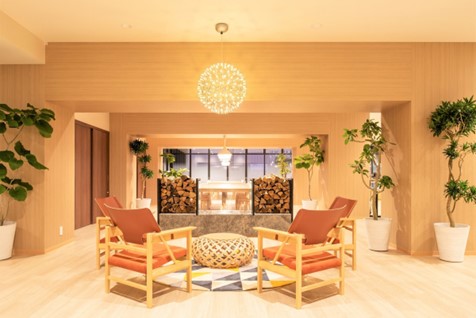
But there was another reason for my “spy mission.” Asahikawa is the mecca of wooden furniture, and many local hotels pride themselves on using furniture made right here in town. I found myself sitting in the lobby, secretly observing how guests interacted with our chairs. Do they look comfortable? Are they touching the wood? I felt like a spy behind enemy lines, except the “enemy” was just a tired traveler enjoying the fruits of our labor.
The Luxury of “not home”
We often think we need to fly ten hours to find an “escape.” But sometimes, the most profound getaway is just a 20-minute walk away. In a world where our digital lives have blurred the lines between “office” and “bedroom,” checking into a local hotel is a way to reclaim your headspace. It’s a chance to sit on a well-crafted chair, look at a familiar view from a new angle, and remember that you are more than just your job.
You shouldn’t have to check into a hotel just to escape the stress of your daily life. The right piece of furniture can turn even a “work-from-home” corner into a sanctuary of art and comfort. Our “Hatsune Miku Art Chair” is designed to be that bridge—a piece that brings the “extraordinary” of a high-end gallery directly into your “ordinary” living room. Why not invest in a seat that reminds you to breathe, even when the laptop is still open? Don’t just live in your home; make it a place worth staying in.

Photo Credit: https://uk.hotels.com/ho2270304928/hotel-amanek-asahikawa-asahikawa-japan/?q-rooms=1&locale=en_GB&pos=HCOM_UK&q-room-0-children=0&q-room-0-adults=2

Shungo Ijima
Global Connector | Reformed Bureaucrat | Professional Over-Thinker
After years of navigating the rigid hallways of Japan’s Ministry of Finance and surviving an MBA, he made a life-changing realization: spreadsheets are soulless, and wood has much better stories to tell.
Currently an Executive at CondeHouse, he travels the world decoding the “hidden DNA” of Japanese culture—though, in his travels, he’s becoming increasingly more skilled at decoding how to find the cheapest hotels than actual cultural mysteries.
He has a peculiar talent for finding deep philosophical meaning in things most people ignore as meaningless (and to be fair, they are often actually meaningless). He doesn’t just sell furniture; he’s on a mission to explain Japan to the world, one intellectually over-analyzed observation at a time. He writes for the curious, the skeptical, and anyone who suspects that a chair might actually be a manifesto in disguise.
Follow his journey as he bridges the gap between high-finance logic and the chaotic art of living!