
The great Japanese dilemma: Ramen or Curry?
Every Japanese person, at some point, is forced to answer a truly stupid question: “If you were stranded on a deserted island and could only eat one food for the rest of your life, would it be Ramen or Curry?” It’s the ultimate civil war of the Japanese palate. For me, the answer is Curry, hands down. But the statistics tell a different story. Japan has roughly 24,000 Ramen shops compared to only 4,700 Curry restaurants. Why the gap? Because Ramen is a “night out” food, while Curry is the undisputed king of the Japanese home.
When I was a kid, my mother would cook a pot of curry that was roughly the size of a small swimming pool. We had to eat it for three days in a row. Day 1: Fresh and exciting. Day 2: The flavors have deepened, but the excitement is waning. Day 3: The “Ordeal.” In a home ruled by a democratic leader, day three might bring “Curry Udon” or “Curry Fried Rice” to soothe the citizens. But my home was an absolute dictatorship. My mother showed zero concern for the people’s grievances. The exact same curry would appear on the table for the third night, and we—the terrified subjects—would eat it in total, fearful silence. This culinary marathon is a rite of passage that still defines Japanese domestic life.
Hokkaido’s spicy rebellion: Soup curry
Hokkaido is already a legendary Ramen kingdom, but we are also a titan in the world of Curry, ranking 3rd in the nation for restaurants per capita. However, we don’t do things the standard way.
While typical Japanese curry is a thick, brown sauce, Hokkaido is the birthplace of Soup Curry. It is a light, spicy broth served separately from the rice, often loaded with huge, colorful chunks of Hokkaido’s famous vegetables.
I once took a group of Indian clients to a local soup curry spot. I felt a surge of nervous pride watching them—the masters of spice—tasting our local creation. To my delight, they loved it. Most shops allow you to choose a spice level from 1 to 10. While the average Japanese person hovers around a level 4, these “Spice Elites” finished their level 10 bowls with perfectly cool faces. It was a humbling moment that made me realize the vastness and the terrifying “level difference” of the outside world.

A seat at the table of design
Usually, I try to find a restaurant that uses CondeHouse furniture, but today I want to invite you to a different kind of experience.
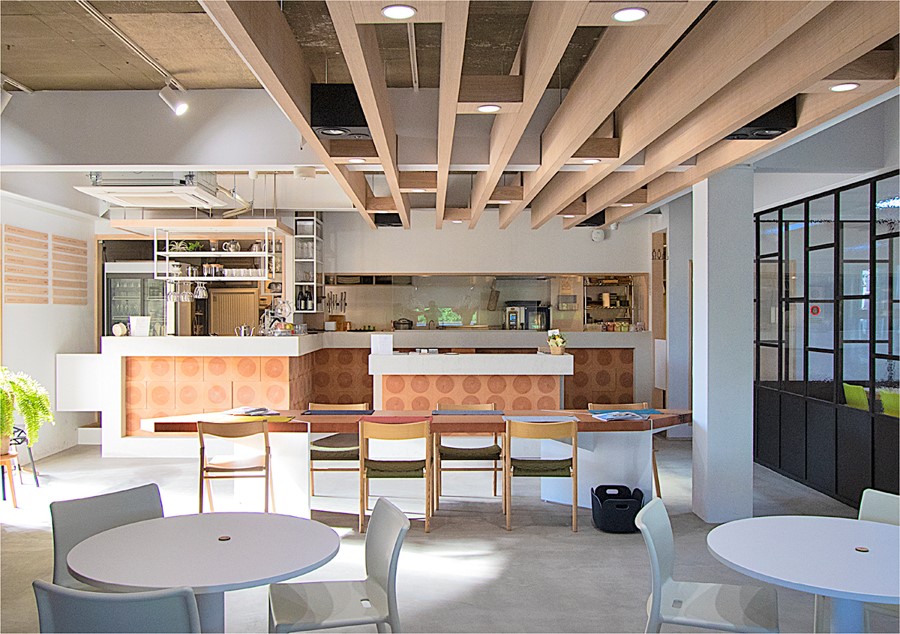
Inside the Asahikawa Design Center (ADC), you can explore the craftsmanship of about 40 different furniture manufacturers from our hometown. It’s a forest of high-end chairs, tables, and sofas. And right there, amidst all that world-class design, is a restaurant where you can sit on some of these very chairs and enjoy a bowl of curry.
It isn’t a specialized curry shop, but in Hokkaido’s cutthroat “Curry Market,” a dish doesn’t survive on a menu unless it’s exceptional. Think of it as a “behavioral exhibit” for your taste buds: you get to test the ergonomics of our chairs while testing the depth of our local spices. It’s the most “Asahikawa” way to spend an afternoon I can imagine.
I confess that I have a profound respect for the ‘3-day curry’—because any dish that can survive as a domestic staple (or a dictatorship) must have a depth that never fades. At CondeHouse, we strive for that same enduring quality. We don’t just make furniture to be looked at; we make it to be lived in, sat upon, and tested by the rigors of daily life. Our Hatsune Miku Art Chair is the ultimate ‘Hokkaido blend.’ It combines the vibrant, spicy energy of our local food culture with the ergonomic perfection we’ve refined over decades. It’s a masterpiece that doesn’t just fill a room; it satisfies your soul, much like a level-10 bowl of soup curry on a freezing winter day. Now, here is a portal to a design you can truly ‘savor’: the image below is your link to the special site. If you prefer the bland, tasteless experience of the ordinary, do NOT click it. But if you’re ready to taste the peak of Asahikawa craft, go ahead. Take your seat at the table. —— The Hatsune Miku Art Chair.

Photo Credit: https://asahikawa.hokkaido-np.co.jp/2019/10/04/vol-814-palemta%EF%BC%88%E3%83%91%E3%83%AC%E3%83%B3%E3%82%BF%EF%BC%89/

Shungo Ijima
Global Connector | Reformed Bureaucrat | Professional Over-Thinker
After years of navigating the rigid hallways of Japan’s Ministry of Finance and surviving an MBA, he made a life-changing realization: spreadsheets are soulless, and wood has much better stories to tell.
Currently an Executive at CondeHouse, he travels the world decoding the “hidden DNA” of Japanese culture—though, in his travels, he’s becoming increasingly more skilled at decoding how to find the cheapest hotels than actual cultural mysteries.
He has a peculiar talent for finding deep philosophical meaning in things most people ignore as meaningless (and to be fair, they are often actually meaningless). He doesn’t just sell furniture; he’s on a mission to explain Japan to the world, one intellectually over-analyzed observation at a time. He writes for the curious, the skeptical, and anyone who suspects that a chair might actually be a manifesto in disguise.
Follow his journey as he bridges the gap between high-finance logic and the chaotic art of living!