
The global anomaly: The synchronized start of careers
In Japan, the academic year for almost all schools (elementary through university) runs from April to March. Consequently, March is the season of graduation. As this may sound strange outside Japan, all high school and university graduates join companies and start working in April, all at once. This synchronized recruitment process is highly unusual globally.
For a full year before graduation, many companies hold recruiting sessions to hunt promising youths, and final-year university students spend most of their time in those sessions, often neglecting classes. I remember my senior year: I rarely saw my classmates on campus. Even when I did, their neat and tidy suits for recruiting sessions only made me feel melancholy. The system is intense, reflecting that the idea of lifetime employment, though weakening, remains strong in our subconscious. Accordingly, almost all companies hold their Entrance Ceremonies (Nyūsha-shiki) in April.
The great attitude adjustment: Why ceremonies are crucial
I must confess to my lack of foresight: I was such an idiot that I failed to think seriously about job hunting in my senior year. Consequently, I changed jobs twice and experienced three different entrance ceremonies in only three years after graduation.
What I learned from this rather abundant (and slightly embarrassing) experience is that entrance ceremonies focus intensely on changing the attitudes of new graduates for the work awaiting them. In Japan, more than 30% of new graduates leave their first job within three years. Given this statistic, Entrance Ceremonies serve a critical, almost desperate, role as an awareness-raising event designed to avoid that worst-case scenario.
My own career started in the military, and I didn’t need any ceremony because a mandatory GI haircut instantly roused me from my lazy university life. General companies cannot force such a dramatic physical transformation, of course. This is why well-managed Japanese companies view the Nyūsha-shiki as an important moment for collective psychological conditioning.
The grand gesture: Lessons from Toyota’s CEO
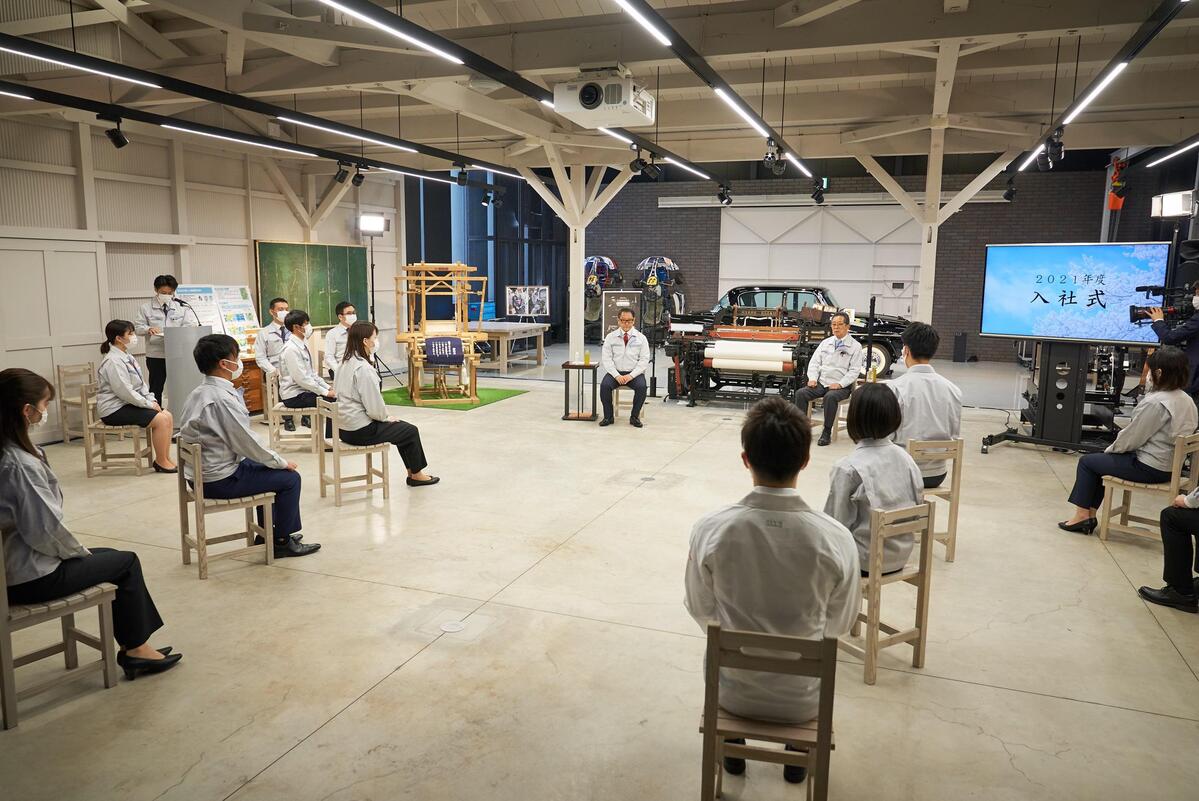
To understand the psychological power of these ceremonies, consider the example of Toyota. I greatly respect the CEO, who is from the founding family but climbed to the top after enduring all kinds of corporate hardships without special treatment from his father.
In the 2019 entrance ceremony (see image for an earlier example), he literally revved the engine of a sports car on the stage. He later explained with a smile, “They would forget my speech soon, but not the engine revving sound.” While the visual spectacle was brilliant, his speeches are actually always amazing. You can clearly see he selects every single word and phrase with utmost care. This combination of theatrical genius and intellectual rigor is exactly why these events matter.
The self-serving conclusion: A crisis at CondeHouse
Next week, we will welcome new faces at our own company, CondeHouse. Of course, we will hold our own entrance ceremony, followed by a one-week training session. This standardized system is generally effective for a company of our size (between small and medium).
But here is the real issue that concerns me, the humble author: We, the general managers of the respective divisions, are scheduled to give lectures about our business affairs. The thought of standing on a stage, tasked with inspiring—or at least, not demoralizing—a fresh group of high-potential youths, fills me with existential dread.
May the force be with me not to ruin the company’s carefully curated efforts. (The fact that I am worried about my own speaking performance rather than the new employees’ future shows that the human ego, even post-military life, is never truly conditioned.)

Company entrance ceremony of CondeHouse
Next week, we welcome new faces. Of course, we will have an entrance ceremony. Soon after the ceremony, one-week training sessions will start. I think this system is good for our size company (between small and medium). The problem is we, the general managers of the respective divisions, are supposed to give lectures about our business affairs. May the force be with me not to ruin the company’s efforts.
I may be trembling at the thought of giving a lecture that won’t instantly demoralize our new recruits, but I’ve realized that if my words fail to inspire them, our furniture certainly won’t. Like the roar of a Toyota engine, some things are felt rather than heard. Our Hatsune Miku Art Chair is the ultimate ‘Entrance Ceremony’ for your home—a piece that instantly resets your perspective and awakens your senses. It’s crafted with the same careful selection of ‘words’ and ‘materials’ that I’m currently agonizing over for my speech, but with much more reliable results. If you’re looking for a dramatic transformation of your living space that requires no mandatory haircut or corporate conditioning, look no further. Sit down, find your focus, and may the force be with your interior design. —— The Hatsune Miku Art Chair.

Photo Credit: https://toyotatimes.jp/en/spotlights/134.html

Shungo Ijima
Global Connector | Reformed Bureaucrat | Professional Over-Thinker
After years of navigating the rigid hallways of Japan’s Ministry of Finance and surviving an MBA, he made a life-changing realization: spreadsheets are soulless, and wood has much better stories to tell.
Currently an Executive at CondeHouse, he travels the world decoding the “hidden DNA” of Japanese culture—though, in his travels, he’s becoming increasingly more skilled at decoding how to find the cheapest hotels than actual cultural mysteries.
He has a peculiar talent for finding deep philosophical meaning in things most people ignore as meaningless (and to be fair, they are often actually meaningless). He doesn’t just sell furniture; he’s on a mission to explain Japan to the world, one intellectually over-analyzed observation at a time. He writes for the curious, the skeptical, and anyone who suspects that a chair might actually be a manifesto in disguise.
Follow his journey as he bridges the gap between high-finance logic and the chaotic art of living!