
The leisure trap: Why you can’t quit your job
What would you do if you won a $10 million lottery? Quit your job, charter a plane, and embark on luxury travel? I believe everyone has indulged in this kind of frivolous thought. But let’s get serious for a moment: Are you certain you can keep doing only what you want to do, even if you are entirely alone?
Every time my stock portfolio is up, this question pops into my mind: Quit my job and do what? Leisure time may cease to be fun; perhaps the concept of leisure cannot exist without work in the first place. When I get lost in these ridiculous thoughts, I always remember the last years of Howard Hughes, though I know his life mainly through the movie The Aviator.
Hughes was a millionaire by birth and an industrial titan, but his last years were miserable. He locked himself alone inside a room, commanded his staff remotely, and rarely met anyone. My point is not the naive question of “whether money can buy happiness,” but the more profound one: What is work truly all about for us?
The stylish paradox: Offices designed for absence
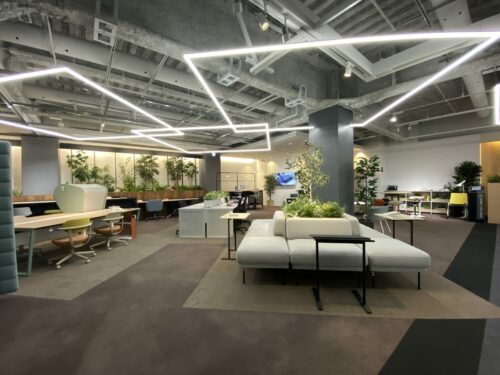
Funnily enough, this existential question about the meaning of work came to the fore last month when I was visiting some stylish and trendy offices in Tokyo, seeking reference points for our own planned office renovation.
We visited the headquarters of several office furniture makers. These companies naturally treated their offices as the ultimate showcase, equipping them with the latest, most beautiful products. Indeed, the offices were so stylish they looked more like popular cafes or restaurants.
But what surprised me was the Stylish Paradox: All of these companies have also fully introduced remote work systems. It’s funny, isn’t it? They invested heavily to build a fantastic working environment, while simultaneously setting up a system where people don’t actually have to come to the office. This forces us all to face a fundamental question: What is the ideal working environment—working together at the office, or alone at home?
The mystery of human connection
For clarity, these furniture makers are not trying to force their staff back to the office. They didn’t even prepare working spaces for 100% of their staff; the maximum expected attendance is around 70% to 80%. They seem to be redefining the “company” back to its original meaning: a group of people heading for the same goal, not necessarily a physical working place.
They are trying to make the environment as comfortable as possible, expecting staff to work most efficiently without stress.
Yet, when I saw people working in those beautiful offices, my mind immediately returned to the image of the isolated Howard Hughes. I couldn’t help but be impressed by the mystery of human nature: Why do we like working together as a team? The average one-way commuting time in Tokyo is about one hour. The workers I saw there want to come to their offices, even at the cost of two hours a day for commuting. Of course, those employees are likely judging the beautiful offices to be worth the long commute. But the underlying drive is deeper than mere aesthetics. It is a profound need to be connected.
Our humble trial: Designing for presence
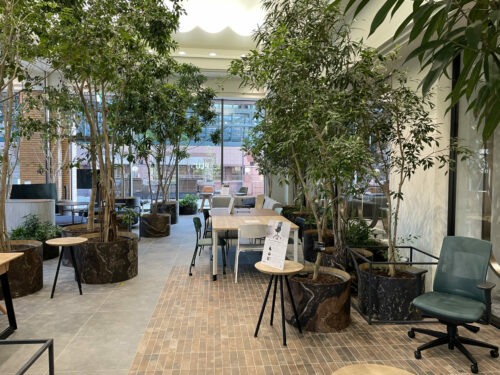
The major renovation of our office will be completed in about six months. We will likely not introduce a comprehensive remote work system yet. Therefore, our goal is slightly different: our new office must be something that does not easily make us tired, prioritizing comfort and human connection over aggressive efficiency.
To be honest, I’m not entirely sure at this moment if we can truly make it the “ideal” environment, but it will be an interesting trial: An ideal working environment proposed by a luxury wooden furniture maker—one designed to encourage connection, not just maximize output. (We will try to prove that the opposite of Howard Hughes is a good chair and a friendly colleague.)
I confess that I am no Howard Hughes; if I won the lottery, I’d probably just buy a slightly more expensive brand of coffee and keep coming to the office to annoy my colleagues. We are social animals, and as the stylish offices of Tokyo prove, we’ll endure almost any commute just to feel connected. Our Hatsune Miku Art Chair is built on this very premise—that a good chair is more than just a place to sit; it’s a physical anchor in a world of remote isolation. We’ve used the same Ultrasuede and Hokkaido timber that will soon define our own office renovation to create a seat that honors the original meaning of ‘company.’ Whether you’re working alone at home or together in the city, this chair is designed to ensure you never feel like a shut-in millionaire. Sit down, stay connected, and let the digital goddess keep the Howard Hughes in you at bay. —— The Hatsune Miku Art Chair.


Shungo Ijima
Global Connector | Reformed Bureaucrat | Professional Over-Thinker
After years of navigating the rigid hallways of Japan’s Ministry of Finance and surviving an MBA, he made a life-changing realization: spreadsheets are soulless, and wood has much better stories to tell.
Currently an Executive at CondeHouse, he travels the world decoding the “hidden DNA” of Japanese culture—though, in his travels, he’s becoming increasingly more skilled at decoding how to find the cheapest hotels than actual cultural mysteries.
He has a peculiar talent for finding deep philosophical meaning in things most people ignore as meaningless (and to be fair, they are often actually meaningless). He doesn’t just sell furniture; he’s on a mission to explain Japan to the world, one intellectually over-analyzed observation at a time. He writes for the curious, the skeptical, and anyone who suspects that a chair might actually be a manifesto in disguise.
Follow his journey as he bridges the gap between high-finance logic and the chaotic art of living!
Comments
List of comments (1)
Vitazen Keto Gummies This is really interesting, You’re a very skilled blogger. I’ve joined your feed and look forward to seeking more of your magnificent post. Also, I’ve shared your site in my social networks!