
The problem with being the star
There’s a well-known saying that you are only the “star” of your own life three times: when you are born, when you get married, and when you die. Only one of those moments—the wedding—occurs while you are fully conscious, which is why people go absolutely crazy planning them. However, since the divorce rate in Japan hovers around 30% annually, the logical conclusion is that you might actually be the star more than three times. (Naturally, I never mention this cynical observation to anyone preparing for a wedding.)
Japanese wedding ceremonies today are less about religion and more about hyper-engineered entertainment. Interestingly, despite market pressure to entertain, the tradition of the bouquet toss is losing popularity. Why? Comments online suggest it makes the catcher look “too needy and desperate for marriage.” Entertainment is a minefield.
I know, I know. My introductions are deliberately meandering. But this discussion of weddings leads us to a crucial ritual: tree planting.

The hope engine: Why we plant trees for the unseen future
A popular addition to modern Japanese wedding ceremonies is the tree planting ritual, where the couple jointly plants a small tree (often an olive tree) to symbolize their burgeoning family. Tree planting has become a universal symbol for celebrating beginnings—whether it’s a marriage or the completion of a new building.
Why does planting a tree always evoke such a powerful, positive feeling?
The answer, I believe, lies in time. A tree’s growth cycle often exceeds the length of a human life. You cannot plant a tree without a radical, almost arrogant degree of hope for a future you will not see. This perfectly aligns with the famous quote, attributed to Martin Luther: “Even if I knew that tomorrow the world would go to pieces, I would still plant my apple tree.” Hope for the future is the only thing that drives us forward, even when the world feels like it’s collapsing.
The 100-Year bet: Oak, responsibility, and barbecue
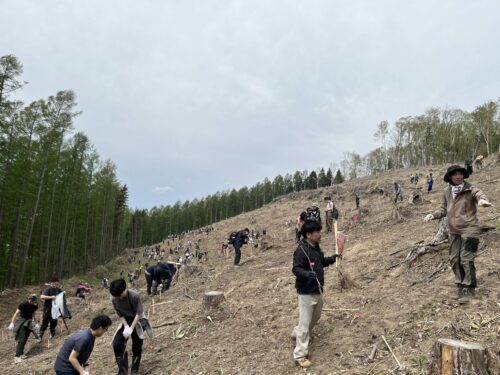
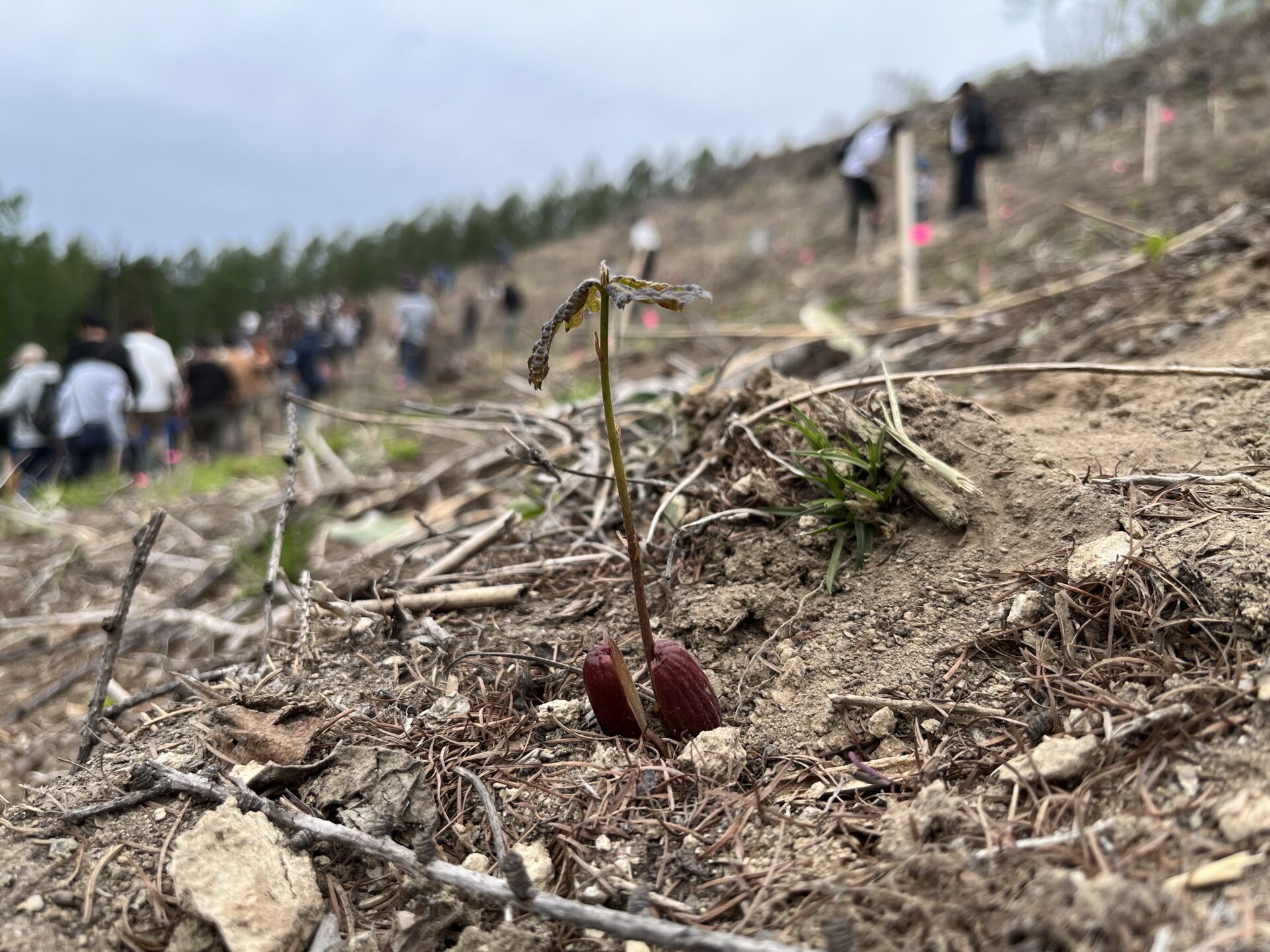
This philosophy is the foundation of our annual ritual here at CondeHouse. We, the people working in the wooden furniture industry in Hokkaido, plant oak trees every year. Last Sunday, about 300 of us gathered and planted 2,000 oak saplings.
Why oak? Because it takes approximately 100 years for an oak tree to grow enough to be harvested for wooden furniture material. Think about that: the children who join us in planting will likely not live long enough to see the resulting furniture. It is the ultimate long-term bet, a quiet acceptance of responsibility for an entirely unseen generation.
It may sound sad, but we genuinely enjoy this annual tree-planting event. And yes, a massive barbecue party is always held afterward, which definitely sweetens the deal. But the true driver is the hope we put into the soil. We are investing in a 100-year legacy, fulfilling the ultimate responsibility of a business that relies entirely on nature: ensuring the raw materials of the future exist, even if they won’t benefit us directly. That is the profound, beautiful irony of our annual ritual.
I confess that I’m a man who plants trees for a future I will never see—a 100-year bet placed with the same defiant hope as Martin Luther’s apple tree. At CondeHouse, our annual ritual of planting 2,000 oaks is a quiet promise to a generation yet unborn. Our Hatsune Miku Art Chair is the first blooming of that long-term legacy: a piece crafted from the same resilient Hokkaido wood and the same unyielding hope for the future. It’s not just furniture; it’s a century of patience turned into high-art and turquoise-green elegance. Now, here is a portal to our most hopeful creation: the image below is your link to the special site. If you prefer the fleeting, disposable objects of the present, do NOT click it. But if you’re ready to sit upon a legacy built for the next hundred years, go ahead. Claim your piece of the future. —— The Hatsune Miku Art Chair.


Shungo Ijima
Global Connector | Reformed Bureaucrat | Professional Over-Thinker
After years of navigating the rigid hallways of Japan’s Ministry of Finance and surviving an MBA, he made a life-changing realization: spreadsheets are soulless, and wood has much better stories to tell.
Currently an Executive at CondeHouse, he travels the world decoding the “hidden DNA” of Japanese culture—though, in his travels, he’s becoming increasingly more skilled at decoding how to find the cheapest hotels than actual cultural mysteries.
He has a peculiar talent for finding deep philosophical meaning in things most people ignore as meaningless (and to be fair, they are often actually meaningless). He doesn’t just sell furniture; he’s on a mission to explain Japan to the world, one intellectually over-analyzed observation at a time. He writes for the curious, the skeptical, and anyone who suspects that a chair might actually be a manifesto in disguise.
Follow his journey as he bridges the gap between high-finance logic and the chaotic art of living!
Comments
List of comments (3)
Temp Mail I appreciate you sharing this blog post. Thanks Again. Cool.
Hi, I’m Jack. Your blog is a treasure trove of valuable insights, and I’ve made it a point to visit daily. Kudos on creating such an amazing resource!
Hi Jack, thank you so much for your interest and thoughtful comment! I’d love to share the beauty of Hokkaido and Japan’s rich culture, hoping that my content will inspire and captivate everyone who reads it. I will do my best to continue to share various interesting contents. Thank you again