

The humiliation of Don Quixote: Spain and the windmills
Don Quixote is arguably the most famous Spanish name in Japan, perhaps even more recognized than Penélope Cruz. Mind you, this doesn’t reflect high cultural standards. Embarrassingly, most Japanese people instantly recognize the name as a major discount store chain with over 600 locations, and may be completely unaware it derives from the title of a classic novel. (You should definitely check out the discount store next time you visit; it’s popular with tourists for its sheer chaos.)
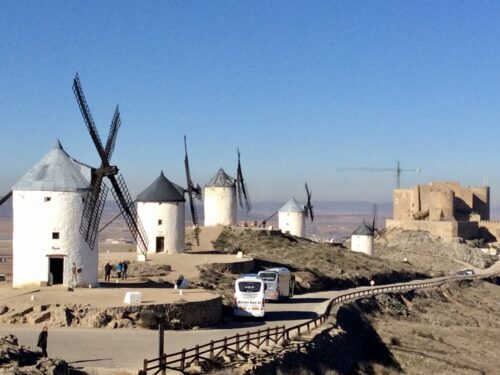
Anyway, Don Quixote, the Man of La Mancha, springs to my mind every time I see the power-generating windmills increasing in number lately.
According to the $2023$ annual report of the Energy Institute, the top five countries in wind power generation capacity are: 1st China, 2nd USA, 3rd Germany, 4th India, and 5th Spain. When I first saw this, I was surprised to see the results roughly matched the world GDP ranking, with the exception of Japan being out and Spain being in. But Spain’s ranking makes sense: there must have been so many windmills there for centuries that Don Quixote mistook them for giants.
The landscape dilemma: Windmills in Hokkaido
Japan, while still ranked around 3rd or 4th in the world GDP ranking, is placed only around 20th in wind power generation capacity. Our country seems to be significantly behind in this field. Perhaps that’s why power-generating windmills are suddenly being built one after another here in Hokkaido.
As the number of windmills increases, a familiar conflict has come to the surface: Windmills protect the environment, but they spoil the scenery at the same time. Now, I repeat the question: Do you like landscapes with many windmills, even though they may save the earth?
To be honest, I am fine with them. This may be because I rarely see them; they are usually built on the windy coastline, and I live in the middle of Hokkaido, far from the sea. My curiosity is kind of excited to see huge windmills lined up along the coast. But, of course, I completely understand the opposing view from people who feel they have lost their familiar, beloved landscape.
The arrogance of classification: Man vs. Nature
Having said that, I have always felt something fundamentally wrong with the common argument against power-generating windmills. People criticize windmills, saying “natural landscapes are spoiled by artificial human structures.” I couldn’t clearly articulate where my feeling of discomfort came from, but I suspected there was a sense of human arrogance hidden in such opinions.
Recently, I came across an essay that perfectly expressed my suspicion. It was written by Stanisław Herman Lem, one of the 20th century’s best sci-fi writers. In summary, he wrote: “If we find an anthill in the field, most of us will regard it as a natural structure, yet we call our houses ‘artificial’ structures. This is because we fundamentally believe we are something beyond nature.”
I am not using Lem’s words as an excuse to destroy the environment. But if we accept that we, in the first place, are part of nature, then a logical shift occurs: A structure built by a human is no more “artificial” than a structure built by an ant or a beaver.
The humility of the anthill: Our oak forest
This essay was incredibly liberating. Previously, I sometimes wavered about our company’s annual tree-planting efforts, which are generally seen as environmentally friendly. The species we plant is always oak only. I worried that since primary forests consist of multiple species, our single-species planting wouldn’t contribute to the restoration of a truly natural forest.
Lem’s essay made me realize that I had been forgetting the most basic truth: We, too, are an organism with inherent limitations and purposes. We plant oak because that is what we are good at, and that is what we need. We don’t have to apologize for our creations.
Don Quixote saw a giant where there was a windmill. Maybe we should stop seeing “artificial blight” where there is just a very tall anthill, built by nature’s cleverest species.
I confess that I used to see human structures as ‘artificial’ intruders, until I realized we are no different from ants building their hills—just organisms using what we know. At CondeHouse, we plant oak because it’s our nature to create, and we don’t apologize for it. Our Hatsune Miku Art Chair is the ultimate ‘natural’ structure: a fusion of Hokkaido timber and digital genius, as organic as an anthill and as visionary as a windmill. It’s not an ornament; it’s our species’ finest craftsmanship. Now, here is a portal to our most ambitious creation: the image below is your link to the special site. If you prefer the arrogance of seeing humans as separate from nature, do NOT click it. But if you’re ready to experience a throne built by nature’s cleverest species, go ahead. Step into our world. —— The Hatsune Miku Art Chair.


Shungo Ijima
Global Connector | Reformed Bureaucrat | Professional Over-Thinker
After years of navigating the rigid hallways of Japan’s Ministry of Finance and surviving an MBA, he made a life-changing realization: spreadsheets are soulless, and wood has much better stories to tell.
Currently an Executive at CondeHouse, he travels the world decoding the “hidden DNA” of Japanese culture—though, in his travels, he’s becoming increasingly more skilled at decoding how to find the cheapest hotels than actual cultural mysteries.
He has a peculiar talent for finding deep philosophical meaning in things most people ignore as meaningless (and to be fair, they are often actually meaningless). He doesn’t just sell furniture; he’s on a mission to explain Japan to the world, one intellectually over-analyzed observation at a time. He writes for the curious, the skeptical, and anyone who suspects that a chair might actually be a manifesto in disguise.
Follow his journey as he bridges the gap between high-finance logic and the chaotic art of living!