
The humiliation of a movie snob: The science behind PIXAR
According to my highly biased personal opinion, many movie enthusiasts (myself included, once upon a time) tend to look down on animated movies. I’m certain of this because I was one of them until I visited a special exhibition in Sapporo titled “The Science Behind PIXAR.” The exhibition detailed the complex production process behind PIXAR’s movies.
If you still believe only dramas played by real actors can truly move you, I insist that CG animation is equally dramatic. You just need to know the background stories of the people struggling behind the scenes.
Springs, shock Absorbers, and the art of the curly hair
At the exhibition, we watched many short videos featuring PIXAR engineers who all reiterated the same core belief: CG animation is the perfect fusion of art and science. After seeing the evidence, I was completely convinced.
Consider a couple of impressive examples:
Brave (2012): The challenge here was Merida’s famously voluminous, curly red hair. To express the natural bounce and movement of her curls, they first monitored the motion of actual springs. They soon found the hair bounced too much, looking unnatural. Their ingenious solution was to effectively install “shock absorbers” into the virtual springs, which finally resulted in perfectly natural, realistic movement.
A Bug’s Life (1998): One of the biggest challenges for the engineers was realistically rendering grass leaves as seen from a bug’s perspective. Their solution? They used complex quadratic functions (yes, high school math is useful!) to create the varied, organic curves of the grass blades.
Sou Fujimoto’s virtual reality: A hometown connection
As surface rendering, lighting, camera angles, and textures continue to improve, the line between CG and the real world will soon be indistinguishable.
Aligning with this trend, we took an ambitious step: we asked the world-famous architect Sou Fujimoto to design a virtual hotel exactly as he liked. Surprisingly, despite his super busy schedule, he kindly agreed to our request—probably because he is a senior alumnus of my high school in Asahikawa, where our company is headquartered. (I know this miracle has absolutely nothing to do with the fact that he is my senior at high school, but I like to think it might have helped.)
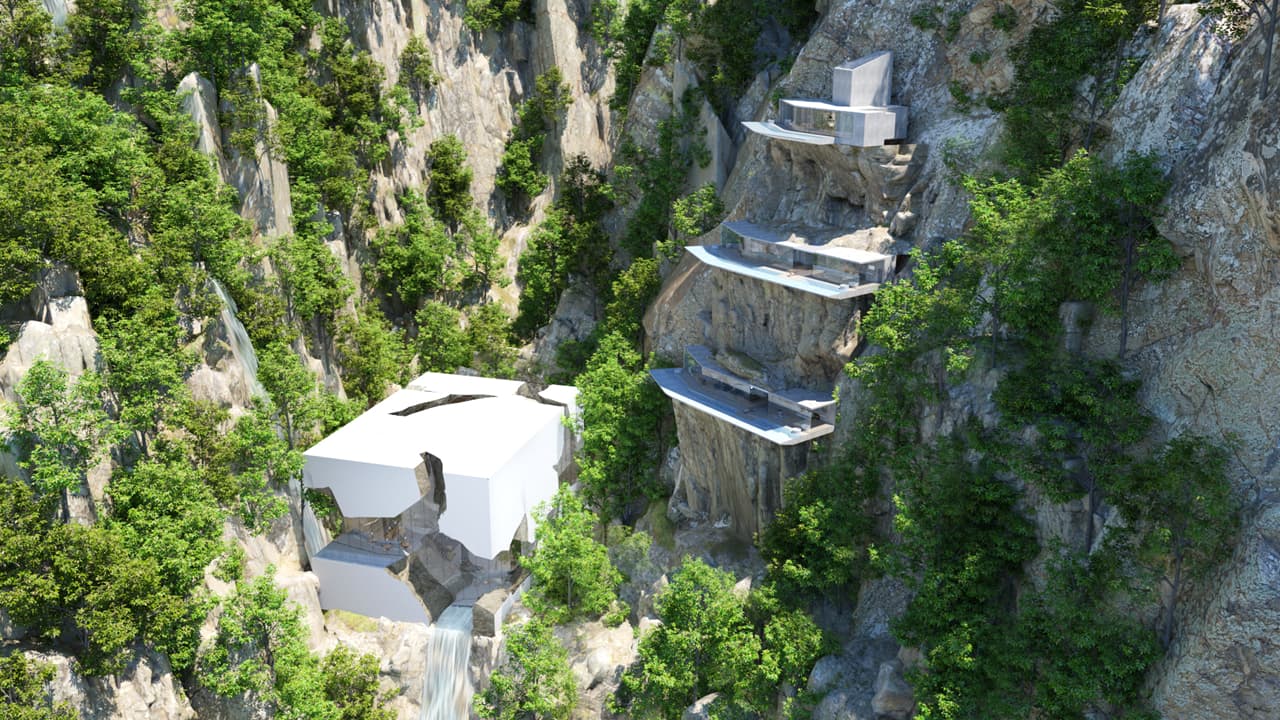
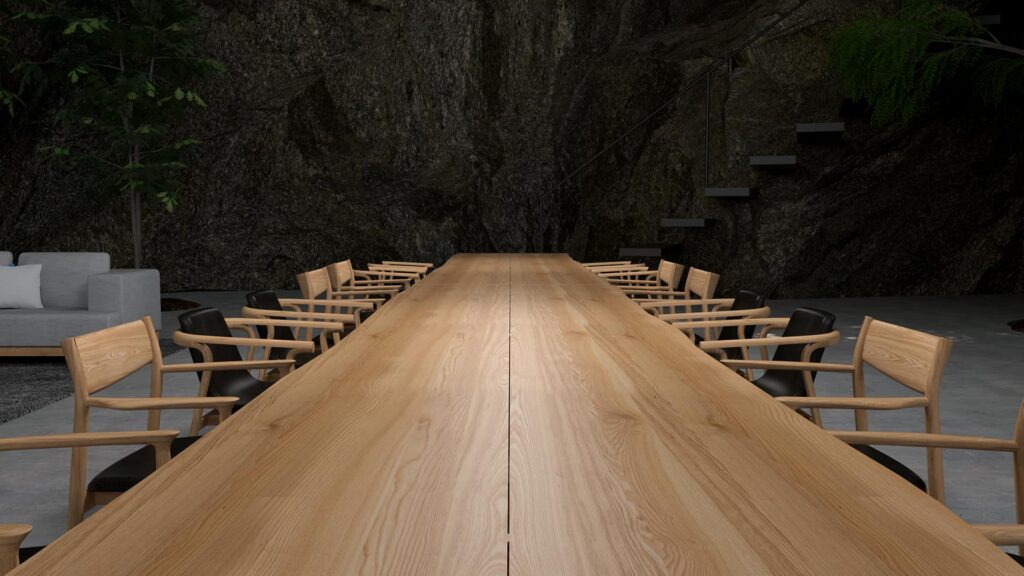
The result of his vision is the “Hokkaido Rock House,” which you can see in the images on this page.
The future of living: Harmonizing human and nature
We specifically requested that he design a hotel set in the iconic and beautiful nature of our hometown, free from all budget and legal restrictions.
His answer is a breathtaking structure designed to harmonize humanity and nature. He explained his philosophical approach: “If it gets too virtual or fanciful, it couldn’t express the charm of nature well. If it becomes too realistic, it will limit the future relationship between human and nature.”
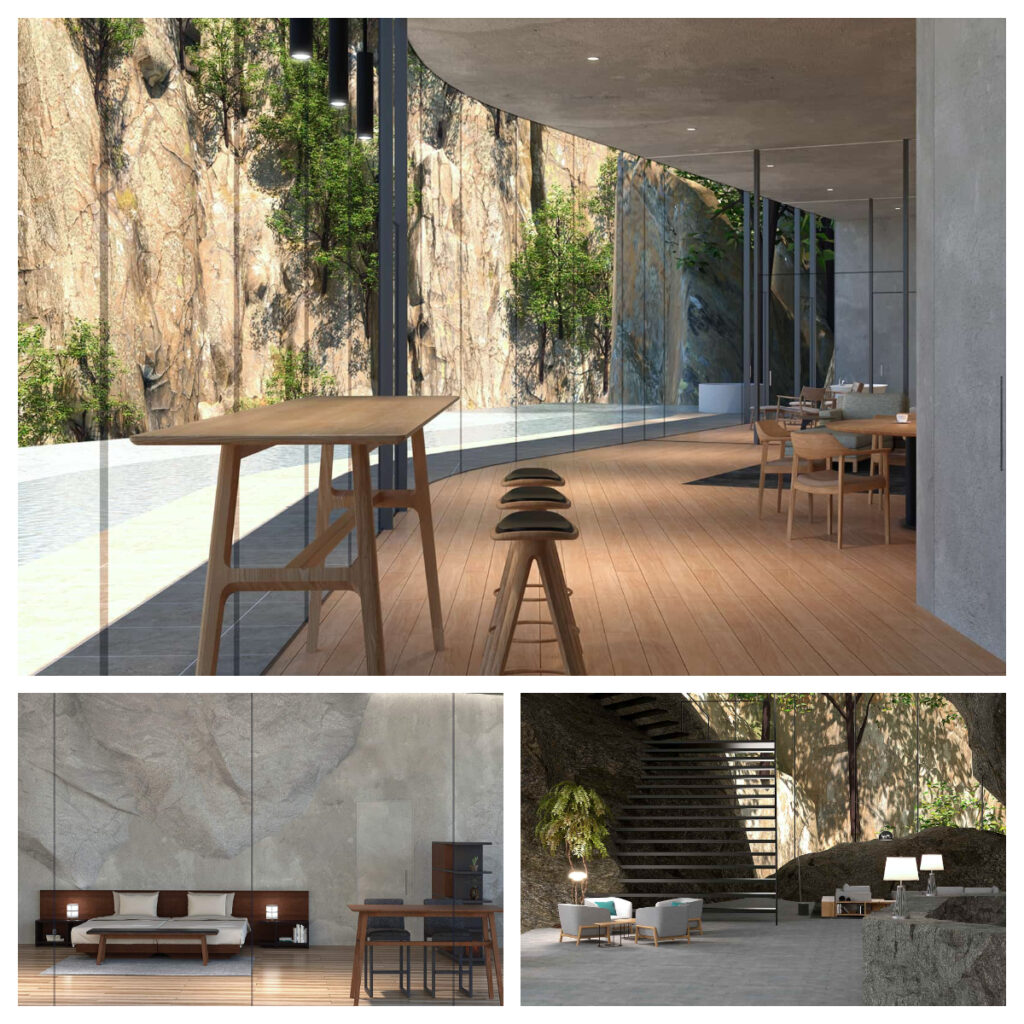
The Hokkaido Rock House exists in the perfect, non-reproducible space between pure imagination and cold reality. It is the future living environment Sou Fujimoto dreams of.
Come and enjoy this beautiful space (virtually, for now)—the pinnacle of design born from a hometown architect’s genius and a little bit of high school network luck.
I confess that I was once a movie snob who looked down on animation—until I realized that it takes high-school math and ‘virtual shock absorbers’ to make a character’s hair bounce correctly. It turns out art is nothing without a little science. We’ve embraced this same fusion in our ‘Hokkaido Rock House,’ a virtual hotel designed by the legendary Sou Fujimoto. I like to think he said yes because we’re alumni of the same high school in Asahikawa, but it’s more likely he was drawn to our shared obsession with harmonizing nature and technology. Our Hatsune Miku Art Chair is the ultimate occupant of this space—a physical masterpiece that feels as perfectly balanced as a Pixar render. Now, here is a portal to a world where budget and gravity don’t exist: the image below is a link to our special site. If you prefer the dull, ‘non-virtual’ reality of ordinary furniture, do NOT click it. But if you’re ready to see how a high-school network and some world-class design can redefine the future, go ahead. Step into the Rock House. —— The Hatsune Miku Art Chair.


Shungo Ijima
Global Connector | Reformed Bureaucrat | Professional Over-Thinker
After years of navigating the rigid hallways of Japan’s Ministry of Finance and surviving an MBA, he made a life-changing realization: spreadsheets are soulless, and wood has much better stories to tell.
Currently an Executive at CondeHouse, he travels the world decoding the “hidden DNA” of Japanese culture—though, in his travels, he’s becoming increasingly more skilled at decoding how to find the cheapest hotels than actual cultural mysteries.
He has a peculiar talent for finding deep philosophical meaning in things most people ignore as meaningless (and to be fair, they are often actually meaningless). He doesn’t just sell furniture; he’s on a mission to explain Japan to the world, one intellectually over-analyzed observation at a time. He writes for the curious, the skeptical, and anyone who suspects that a chair might actually be a manifesto in disguise.
Follow his journey as he bridges the gap between high-finance logic and the chaotic art of living!