
The dawn mission: Witnessing the cult of ice
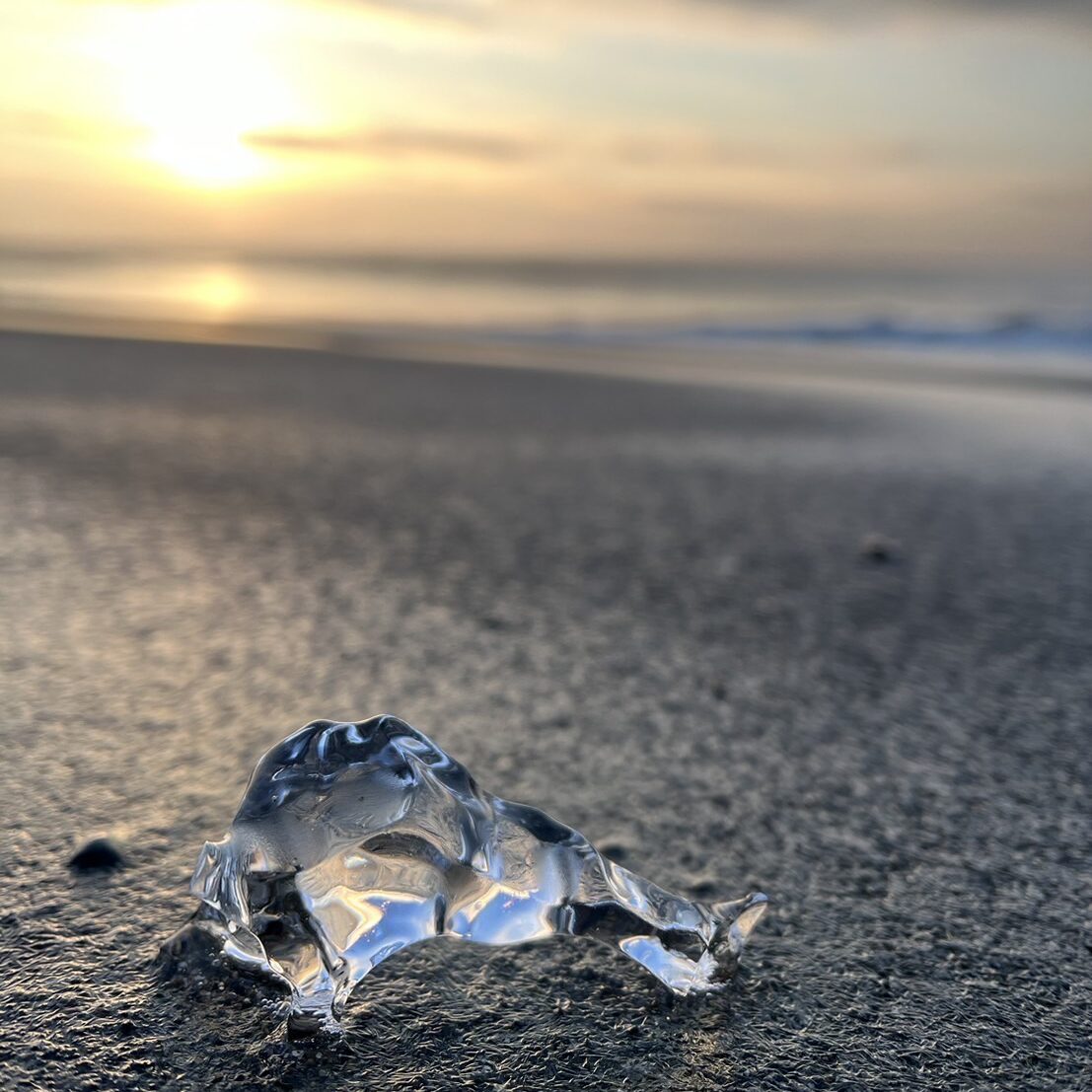
Have you ever heard of “Jewelry Ice?” It’s fundamentally different from sea drift ice; it’s highly transparent, diamond-like freshwater ice that forms at a river mouth. After drifting briefly in the sea, the pieces get rounded and polished before being washed ashore. This phenomenon, according to Wikipedia, occurs almost exclusively along the coast of a specific small town in Hokkaido.
Last weekend, I undertook the 200km mission to see it. I learned that dawn is the best time, as the rising sun reflects off the ice, maximizing its beauty. I stayed nearby, arrived before 5 a.m., and endured the extreme cold to await the sunrise.
The ice was indeed stunning, but honestly, what impressed me more was the sheer number of people gathered there. More than 100 people—including foreigners—in the middle of nowhere, before dawn, in punishing weather. Some people were even lying flat on the freezing ground, aiming huge telephoto lenses at the ice. I, for one, hated having to take my hands out of my pockets just to snap a couple of photos (which I begrudgingly took for this article), so I felt a terror that exceeded respect for these dedicated photographers. But do not judge me a lazy failure! This very diversity is what allowed humanity to flourish. [Note: The images uploaded here are ones I took. Please visit the town’s official website for pictures that truly capture its nature.]
This pilgrimage—this cult of dedicated viewers—highlights the incredible power of a simple idea.
The magic of naming: From river trash to global treasure

I was born and raised in Hokkaido, but I had never heard of “Jewelry Ice” when I was young. My memory is correct: according to Wikipedia, this natural phenomenon was officially named “Jewelry Ice” by a local teacher in 2012.
The phenomenon itself didn’t suddenly appear in 2012; the ice has been washing up there from time immemorial. Local people recall kicking the ice pieces around the beach when they were kids, treating them like worthless river trash. No one paid any attention until someone decided to give it a beautiful name and share beautiful images.
Don’t you find this amazing? A local resident gave this previously worthless ice a magnificent name, shared the images, and suddenly, this small, nameless town became a major sightseeing spot attracting people from overseas.
If it had been named “River Ice” or “Freshwater Ice,” it would have remained ignored. The name “Jewelry Ice” is a masterstroke. This success is not just economic; it’s a triumph of perception. People find and appreciate a new natural wonder, local residents gain pride in their hometown, and the economic benefits flow naturally because money is, in essence, a form of appreciation for perceived value.
The pursuit of ‘Jewelry Wood’

I know the secret is not just good naming; that would be simplistic. The core challenge is learning how to find new, compelling value in common things or everyday occurrences.
However, my inflexible mind keeps clinging to the easiest path: renaming or redefining our products (wooden furniture).
If ordinary ice can become globally famous by transforming into “Jewelry Ice,” what can we achieve? What if we called it “Jewelry Wood?” Perhaps it’s not the name itself, but the deliberate act of reframing the material—highlighting the transparent, diamond-like quality of the resin in the knots, or the rare light reflected by the grain—that matters.
We must find the “Jewelry Ice” moment for our furniture, where we stop seeing it as mere wood and start seeing the breathtaking, polished treasure it truly is.
I confess that I was stunned by the power of a name: how ‘worthless river ice’ became a global treasure just by being called ‘Jewelry Ice.’ It’s a triumph of perception that we’ve taken to heart. At CondeHouse, we no longer see just timber; we see the hidden, polished brilliance within the grain. Our Hatsune Miku Art Chair is the ultimate ‘Jewelry Wood’—a masterpiece where the soul of a digital icon and the diamond-like quality of Hokkaido craftsmanship collide to create a value that never existed before. It is not just furniture; it is a discovery. Now, here is a portal to our most precious ‘jewelry’: the image below is your link to the special site. If you prefer the unremarkable, nameless objects of the ordinary, do NOT click it. But if you’re ready to witness the moment wood becomes a treasure, go ahead. Discover the brilliance. —— The Hatsune Miku Art Chair.


Shungo Ijima
Global Connector | Reformed Bureaucrat | Professional Over-Thinker
After years of navigating the rigid hallways of Japan’s Ministry of Finance and surviving an MBA, he made a life-changing realization: spreadsheets are soulless, and wood has much better stories to tell.
Currently an Executive at CondeHouse, he travels the world decoding the “hidden DNA” of Japanese culture—though, in his travels, he’s becoming increasingly more skilled at decoding how to find the cheapest hotels than actual cultural mysteries.
He has a peculiar talent for finding deep philosophical meaning in things most people ignore as meaningless (and to be fair, they are often actually meaningless). He doesn’t just sell furniture; he’s on a mission to explain Japan to the world, one intellectually over-analyzed observation at a time. He writes for the curious, the skeptical, and anyone who suspects that a chair might actually be a manifesto in disguise.
Follow his journey as he bridges the gap between high-finance logic and the chaotic art of living!
Comments
List of comments (3)
BaddieHub very informative articles or reviews at this time.
Thank you so much.
Blue Techker This is my first time pay a quick visit at here and i am really happy to read everthing at one place