

The tyranny of passion
In the early days of any business, democracy is often a luxury you can’t afford. When you are a newcomer in a kill-or-be-killed market, you don’t have time for a committee meeting. You need a dictator.
Think about it: Without Steve Jobs’ obsessive aesthetic being forced upon the world, it would have taken much longer for beautiful smartphones to become a universal standard. Without Elon Musk, the idea of reusable rockets would still be a fantasy. In a democratic, consensus-based system, it is incredibly difficult to reach a long-term “correct” answer that defies common sense. These kinds of dictators often make the people around them miserable, and I can say from the bottom of my heart that I would absolutely never want to work under them. However, for the greater purpose of human progress, their existence is absolutely necessary.
Our founder was exactly that kind of figure. But his was not a dictatorship of ego; it was a dictatorship of frantic passion. He was a master craftsman and a designer who didn’t just work; he burned. This fire drove him to push himself and everyone around him to the absolute limit.
The great wholesaler rebellion
His first “act of madness” was a revolution in how furniture was sold. At the time, wholesalers held all the power. They decided the prices, they decided the designs, and the manufacturers were little more than their servants.
He said, “No.”
He bypassed the wholesalers and started selling directly to retailers. The industry was furious. Wholesalers pressured other companies to boycott us, and we were pushed to the brink of financial ruin. But he didn’t blink. He reclaimed the sovereignty of the manufacturer. Today, the wholesalers who once ruled the market are mostly gone, but CondeHouse remains. He fought a war so that we could be free to create.

Betting the future on a chair
His second gamble was even riskier. When he founded the company, the “money-maker” in Japan was the traditional chest of drawers. Chairs were still a foreign novelty; most Japanese people still lived on the floor.
Against all advice, he bet everything on dining chairs and tables. He saw a future that didn’t exist yet—a Japan that sat on chairs. That foresight made us the leader in the dining chair market.
Of course, a light this bright creates thick shadows. I’ve heard many stories of talented people who left the company because they couldn’t handle the heat of his passion. He was not an easy man to work for. But as a man who secretly dreams of being an entrepreneur myself, I find myself admiring even those shadows. He built a system that now supports over 1,000 lives in our city of 330,000. That’s not just a business; that’s a legacy built on the stubbornness of a man who refused to follow the tide.
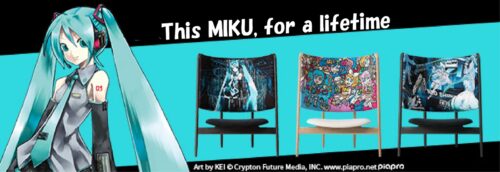
I confess that I admire the ‘mad’ dictatorship of our founder—because without his frantic, unyielding passion, we wouldn’t have the freedom to create something as daring as this. He fought the industry and bet the future on a chair so that we could one day defy common sense ourselves. Our Hatsune Miku Art Chair is the direct descendant of that rebellious spirit. It is a piece that shouldn’t exist in the traditional world of wooden furniture, yet here it is—a turquoise-green masterpiece born from the same refusal to follow the tide. Now, here is a portal to our most defiant creation: the image below is your link to the special site. If you prefer the safe, boring consensus of the crowd, do NOT click it. But if you’re ready to own a piece of a legacy built on raw, uncompromising passion, go ahead. Join the rebellion. —— The Hatsune Miku Art Chair..

Shungo Ijima
Global Connector | Reformed Bureaucrat | Professional Over-Thinker
After years of navigating the rigid hallways of Japan’s Ministry of Finance and surviving an MBA, he made a life-changing realization: spreadsheets are soulless, and wood has much better stories to tell.
Currently an Executive at CondeHouse, he travels the world decoding the “hidden DNA” of Japanese culture—though, in his travels, he’s becoming increasingly more skilled at decoding how to find the cheapest hotels than actual cultural mysteries.
He has a peculiar talent for finding deep philosophical meaning in things most people ignore as meaningless (and to be fair, they are often actually meaningless). He doesn’t just sell furniture; he’s on a mission to explain Japan to the world, one intellectually over-analyzed observation at a time. He writes for the curious, the skeptical, and anyone who suspects that a chair might actually be a manifesto in disguise.
Follow his journey as he bridges the gap between high-finance logic and the chaotic art of living!
Comments
List of comments (4)
[…] mark, shop interior planning, etc., without the approval of the founder, a man of hot blood (see last article). His behavior doesn’t sound so logical? Please remember it was about 40 year ago. I imagine very […]
[…] of logs from Hokkaido. After partaking in a government-funded training program in Europe, he decided to found the furniture company to export furniture made of Hokkaido […]
Hello nnice blog
Thank you! Please enjoy reading other articles, too!