

The genesis of the craze: The Japanese “Gacha” mentality
Have you ever heard the word “Galápagos Syndrome“? Wikipedia defines it as a phenomenon where companies become overly specialized in developing products for the domestic market. In Japan, this started long before high-tech gadgets—it started with kids’ snacks.
Thirty years ago, we were obsessed with a chocolate snack called “Bikkuri-man.” To be precise, we were obsessed with the stickers inside. Every Saturday, the new shipment would vanish from the shelves by evening. The frenzy was so intense it became a national scandal: “rich” kids were reportedly buying boxes, taking the stickers, and throwing the chocolate in the trash.
In my world, we were like a pack of hungry stray dogs. We never had the luxury of wasting food. I remember watching those sticker-hunters with a mix of envy and bewilderment, wishing I could be their friend just to be the one to eat the discarded chocolate. It was my first encounter with a “reversal of value”—where the prize is the product, and the product is the waste.
The Saturday ritual: Chasing the hologram
The reason for our fever was simple: the hit-or-miss system. Every box of 40 contained just one “Head Sticker“—a beautiful, rare hologram.
I remember the heat of those Saturday mornings. We would crowd around the box at the convenience store, annoying the clerks with our loud, desperate theories. “This one! It feels slightly heavier, it must have the head!” “No, no. I heard a rumor that the winner is always in the lower right corner!” We were small-time gamblers, shaking boxes and chasing a one-in-forty chance. This childhood fervor was the true birth of the “Galápagos-ization” of our consumer culture.
The miniature soul: From Bonsai to the palm of your hand
The market—a battlefield where human desires collide—often reveals a curious truth: what truly attracts us is often not the “main” item, but the meticulous world attached to it. Interestingly, the obsession with baseball cards in the U.S. also began as a “shokugan” (candy with a toy) trend, originally included with tobacco and chewing gum. But while that spark evolved into a card-collecting culture elsewhere, Japan took this global human ego and pushed it to an almost obsessive, three-dimensional extreme.
Only in Japan has the “shokugan” industry evolved into such a massive, sophisticated market centered on physical miniatures. It is a world where the $1 snack is merely a pretext; the real prize is a toy crafted with such “abnormal” precision that it commands a serious premium among adult collectors. I believe this stems from our historical inclination toward miniaturization. Look at Bonsai. For centuries, we have sought to re-construct the vastness of nature into a palm-sized masterpiece. We have a cultural DNA that obsessively tries to capture the entire universe in something small enough to hold. This is why the Gacha—originally a simple American import—mutated in Japan into a multi-billion dollar “world in a capsule.”
The design breakthrough: The leftover coin strategy
A few years ago, I was walking through an international airport in Japan and saw massive rows of Gacha machines. At first, I didn’t understand why they were there.
Then, I stopped and looked at the sign. It read: “Take advantage of your leftover JPY coins!” The strategy hit me like a lightning bolt. As a frequent traveler, I knew the headache of foreign coins—too confusing to count, too small to exchange, they just clutter your wallet. Statistics show about $2 billion in coins leaves Japan every year.
It was a brilliant observation of human behavior. These machines require no power and run 24/7. In the middle of the night, when all the duty-free shops are closed, there are always travelers with too much time and a pocket full of “useless” metal. The designers turned a nuisance into an experience.
The power of empathy: Making the world a little better
This is the true power of design. The creators didn’t just make a “cool toy”; they demonstrated empathy for a hidden, universal need. They solved a logistical problem with a hit of dopamine and a piece of miniature culture.
By the power of design, “Galápagos-ization” shifted to Globalization. This project was even recognized with the Good Design Award in 2018. Even at Asahikawa Airport, near our factory, you’ll find these machines. When you come here, please try the Gacha and use up your coins! It’s the most fun way to participate in a global design success.
The rare prize: A chair for the bold
I may have swapped my childhood obsession with holographic stickers for a career in high-end furniture, but I am still that same boy, chasing the “rare prize” with everything I’ve got.
Our Hatsune Miku Art Chair is the ultimate “Head Sticker” of the interior world—a rare masterpiece that rewards those with an inquiring mind. We’ve taken the same design empathy that solved the coin problem and used it to solve an older one: how to make a room feel truly iconic. You don’t need to shake the box or guess the weight; you already know this is the winning pack.
Come to Hokkaido, use your coins at the airport, and then come see the grand prize that’s waiting to transform your home. —— The Hatsune Miku Art Chair.
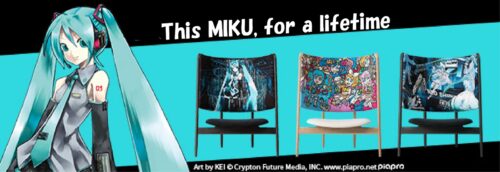
Photo credit: https://prtimes.jp/main/html/rd/p/000000057.000009185.html

Shungo Ijima
Global Connector | Reformed Bureaucrat | Professional Over-Thinker
After years of navigating the rigid hallways of Japan’s Ministry of Finance and surviving an MBA, he made a life-changing realization: spreadsheets are soulless, and wood has much better stories to tell.
Currently an Executive at CondeHouse, he travels the world decoding the “hidden DNA” of Japanese culture—though, in his travels, he’s becoming increasingly more skilled at decoding how to find the cheapest hotels than actual cultural mysteries.
He has a peculiar talent for finding deep philosophical meaning in things most people ignore as meaningless (and to be fair, they are often actually meaningless). He doesn’t just sell furniture; he’s on a mission to explain Japan to the world, one intellectually over-analyzed observation at a time. He writes for the curious, the skeptical, and anyone who suspects that a chair might actually be a manifesto in disguise.
Follow his journey as he bridges the gap between high-finance logic and the chaotic art of living!