

The blowfish paradox: A calculated risk for questionable taste
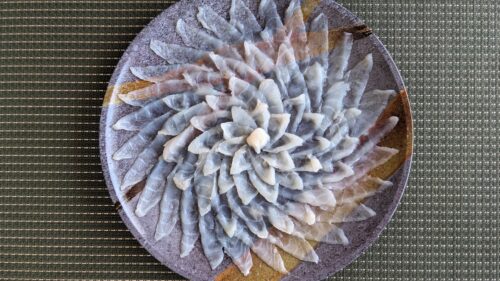
I didn’t know until recently that people rarely eat blowfish (fugu) outside Japan. As you know, the fugu poison, tetrodotoxin, is extremely potent; a popular Japanese blowfish can kill about 10 people. We may look crazy and reckless, but I assure you that Japan is the safest place in the world to eat fugu because preparation, distribution, and disposal are strictly controlled by law. Why don’t you challenge yourself and give it a try when you come to Japan? (I’ll wait outside.)
Do I eat it often? Absolutely not! Fugu is a luxury food, and honestly, I personally don’t think it’s particularly delicious. Many Japanese people are skeptical about the taste, often saying, “I can only taste the sauce,” or “I don’t know why it’s that expensive.” In this world, some luxury foods exist purely as “symbols” of status, despite their questionable taste. Caviar is just incredibly salty fish eggs; foie gras is a lump of fat; and dried sea cucumber? It’s basically tyre debris (though I’ve never been hungry enough to actually test that theory). But fugu is in a league of its own. It’s the only expensive delicacy that is not only mediocre in taste but also carries a legitimate risk of killing you.
What truly baffles me is this: What made ancient people try to eat fugu in the first place? It’s not universally delicious, and Japan, being surrounded by the sea, has countless other tasty fish. The only possible explanation is the most powerful human motivator: insatiable curiosity.
The uncontrollable urge: Why we shock ourselves for nothing
The proverb, “Curiosity killed the cat,” doesn’t quite resonate in Japan because we don’t have the same cultural concept of cats having nine lives. However, a recent behavioral science experiment I read about suggests the proverb is profoundly accurate—and confirms that curiosity may be the only force powerful enough to drive ancient Japanese people to risk their lives for fugu.
To illustrate how uncontrollable our curiosity is, consider this experiment: Researchers prepared a set of mechanical pencils, one of which delivered a small electric shock when clicked. University students were divided into two groups. Group A was told how to identify the electric pencil. Group B was only told one electric pencil was included. Both groups were asked simply to wait in a room with the pencils.
The result? Significantly more students in Group B clicked the pencils and got shocked repeatedly. Funnily enough, they continued to get shocked for nothing—only for the pure satisfaction of resolving their curiosity. The experiment proves that we can’t stop our curiosity until we die, even when the consequence is immediate, painful, and utterly useless.
The coffee mystery: A logistical nightmare born of curiosity
Doesn’t this deep-seated human nature solve many mysteries about food? Think about Nattō (Japanese fermented soybeans)—why did our ancestors decide to let perfectly good soybeans rot and transform into such a horrific form? It seems the curiosity etched into our DNA overpowers individual preference or even the fear of death. As Richard Dawkins might suggest, our “selfish genes” force us to be curious even when it risks the survival of the individual. Nattō, despite its smell and appearance, turned out to be healthy—but it was our reckless curiosity that took the first bite.
If we think clearly and calmly, coffee must have been quite a challenge, too. Why did someone decide to take the inedible seeds of a coffee cherry, roast them, mill them, and pour boiling water over them? The process is so complex it feels like a ritual from an ancient book of spells. I cannot fathom why anyone would burn with such obsession for a mere seed, but regardless, curiosity or our DNA made it happen.
The punchline: You can’t help but try our smoked coffee
Finally, I’ve reached the punchline of this article: Today, let me introduce our new product: Hokkaido Smoked Coffee!
We are a wooden furniture maker and are always trying to reduce wood waste, but we can’t make it zero. A large amount of wood chips and dust is produced every day. We collect these wood remnants in our factory and send them to a coffee roaster in Sapporo, where they smoke their coffee beans using our wood chips.
Currently, the wood species used for our furniture are Oak, Ash, Birch, Sakura, Elm, and Sen. We use them separately, and the Hokkaido Smoked Coffee is offered in six different wood species—each with a unique flavor profile. It will be released this September (2024).
Don’t pretend you aren’t curious. As the experiment proved, you can’t help yourself. Let us know if you want to risk a small shock (of flavor) to satisfy your undeniable human curiosity!
I am exactly like those students in the experiment; tell me not to click the electric pencil, and I’ll be the first one to get shocked—all for the sake of ‘knowing.’ This same reckless curiosity is what led us to turn our wood chips into smoked coffee, and it’s what led us to create our most daring piece of furniture yet: the Hatsune Miku Art Chair. It is the ‘fugu’ of the interior world—rare, slightly dangerous, and utterly captivating. Now, I should probably warn you: the image below is a direct link to our special website. If you are a rational person who wishes to avoid a sudden ‘shock’ of inspiration and digital beauty, you should definitely NOT click it. But as science has proven, your brain won’t let you rest until you find out what’s on the other side. Go ahead—satisfy the urge. We’ll be waiting for you. —— The Hatsune Miku Art Chair.


Shungo Ijima
Global Connector | Reformed Bureaucrat | Professional Over-Thinker
After years of navigating the rigid hallways of Japan’s Ministry of Finance and surviving an MBA, he made a life-changing realization: spreadsheets are soulless, and wood has much better stories to tell.
Currently an Executive at CondeHouse, he travels the world decoding the “hidden DNA” of Japanese culture—though, in his travels, he’s becoming increasingly more skilled at decoding how to find the cheapest hotels than actual cultural mysteries.
He has a peculiar talent for finding deep philosophical meaning in things most people ignore as meaningless (and to be fair, they are often actually meaningless). He doesn’t just sell furniture; he’s on a mission to explain Japan to the world, one intellectually over-analyzed observation at a time. He writes for the curious, the skeptical, and anyone who suspects that a chair might actually be a manifesto in disguise.
Follow his journey as he bridges the gap between high-finance logic and the chaotic art of living!